 by UNI-Prep Institute · Updated August. 26, 2026
During the Industrial Revolution in the eighteenth century, when British workers saw the power loom, many feared their livelihoods were coming to an end. In the twentieth century, when computers entered offices, it was also said that countless jobs would disappear. The same kind of anxiety arose during the spread of the internet. But the lesson of history is that technology has never simply destroyed jobs, rather it has changed the character of the labor market and given birth to new economies and new employment. Artificial intelligence, or AI, is the latest and perhaps the most powerful chapter of that same continuity.
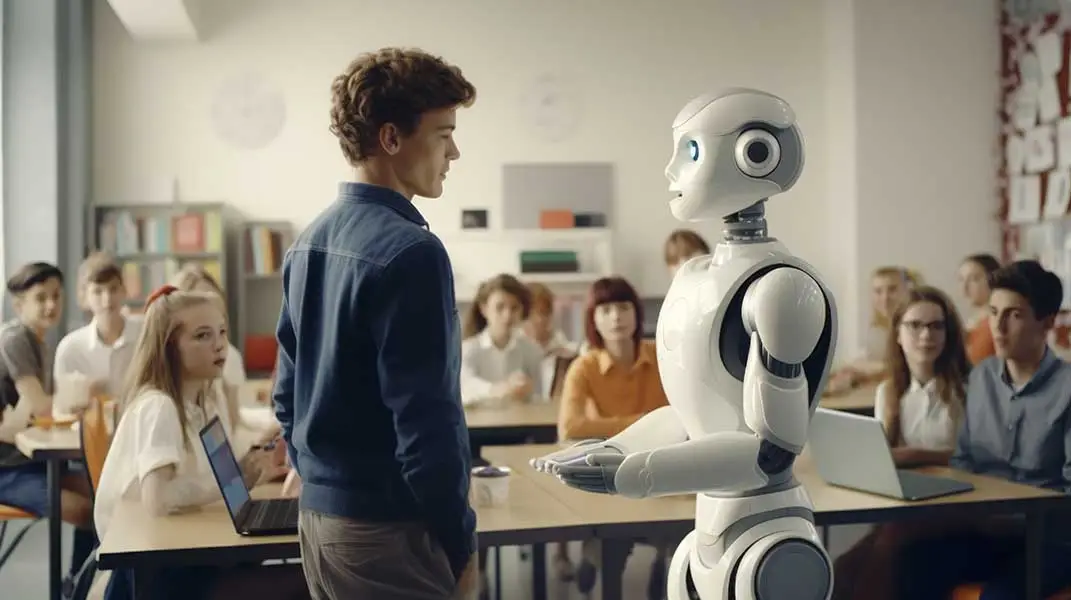
A new idea has now come up for discussion in the tech sector: "flat is the new up." That is, growth is possible even without increasing the number of employees. Instead of hiring new staff, large companies have started using "AI agents" for specific tasks. Even schools, colleges, and universities are not outside this trend. As a result, one question is becoming increasingly loud: will AI take away our jobs? Neither "yes" nor "no" alone is the correct answer to this question. The reality is more complex. So in today's article, we will discuss:
What AI is actually good at, and what it is not
What teachers are saying about this
What the real impact is on the job market
What English teachers should do
AI will reduce some tasks, change the nature of some tasks, and also create entirely new kinds of work. So the biggest challenge of the future is not technology, but human preparedness.
What AI Is Actually Good At, and What It Is Not
Regarding the effectiveness of artificial intelligence (AI) or educational technology (EdTech) in teaching English, many scientific and empirical studies have been conducted worldwide. Below is a detailed account, backed by specific evidence from several international meta-analyses and institutional studies published between 2023 and 2026.
What AI Is Best At
1. Increasing Vocabulary and Writing Accuracy
A large-scale meta-analysis published in 2025, "Effectiveness of Artificial Intelligence (AI) in language teaching," found that compared to traditional methods, AI-based education had a significant positive effect (g = 0.74) on students' five language skills. Among these, the strongest effect was seen in vocabulary acquisition. Currently, AI-powered tools do an outstanding job of correcting grammatical errors in real time, selecting the right words, and restructuring sentences.
2. Pronunciation and Speaking Fluency
Tools for pronunciation enhancement like ELSA Speak or Microsoft Azure Speech are helping students speak with the correct accent and clear pronunciation through real-time phonetic feedback. Through speech recognition technology, AI can analyze every sound a student makes.
3. Reducing the Student's Fear or Hesitation (Reducing Foreign Language Anxiety)
A meta-analysis of 23 experimental studies by researchers has proven that the use of AI tools significantly reduces students' "anxiety" in learning a language and increases their interest in learning. The embarrassment one feels speaking incorrect English in front of people is not present when talking with a chatbot.
4. Personalization and 24/7 Learning
Based on a student's own aptitude, strengths, and weaknesses, AI can create customized lesson plans and remain ready to help 24 hours a day.
What AI Absolutely Cannot Do
1. Failing to Understand Cultural Depth and Idioms (Cultural Nuances, Idioms and Sarcasm)
A report on the Limitations of AI in Language Learning by language learning studies has shown that AI often translates common idioms literally, which destroys the true meaning and fluency of a sentence. AI analyzes language in a literal sense, or through mathematical formulas. AI cannot grasp the social context within a language, sarcasm, humor, or the meaning of regional culture (cultural context).
2. Lack of Human Emotion and Motivation (Lack of Empathy and Emotional Connection)
A 2025 research paper, "AI in Revolutionizing English Language Teaching," clearly states that although AI can correct basic grammar, it fails to provide the psychological challenges behind a student's learning and the emotional and motivational support needed for high-level exams like IELTS or TOEFL. AI is unable to understand when a student is falling behind mentally, or the psychological reasons or fears behind why they cannot understand a lesson. It cannot give human-like emotional encouragement.
3. Inability to Build Long-Term Self-Discipline and Self-Regulation
While AI helps with immediate task completion, it cannot build self-regulated and long-term autonomous learning habits among students. AI can help students finish any assignment or task quickly, but it cannot build within a student the habit of learning independently over the long term.

What Teachers Are Saying
There is deep discussion happening among teachers worldwide about whether AI will completely take away the jobs of English teachers. According to several recent international surveys and studies, most teachers believe AI will not eat their jobs, but it will completely change the nature of their work. Teachers see this not as a threat but as a "helping tool" or assistant.
1. Teachers' Perspective
One of the largest and most reliable surveys of teachers was conducted by the British Council. A 2025 to 2026 survey of 1,348 English teachers from 118 countries found that 51 percent of teachers do not believe AI alone, without human help, will be able to teach English by 2035. 70 percent of teachers think that no matter how advanced AI becomes, students should learn to write and speak English through their own skill, not by becoming dependent on AI. According to data from the PwC Global AI Jobs Barometer, even in the age of AI, employment in the teaching profession has grown by about 38 percent, even in the areas where the chance of automation was the highest, rather than declining.
2. Why Are Teachers Confident Their Jobs Won't Be Lost?
According to teachers and linguists, language education is not simply a matter of memorizing grammar, it is a social and psychological process, which AI alone can never fully accomplish. The teachers' arguments are as follows:
The emotional layer and building confidence: Students generally do not stop speaking English because of a lack of grammar, but rather they stop speaking out of social embarrassment or fear of making mistakes. The mental courage or safe space a teacher can give a student is something AI, which can only point out mistakes, cannot provide.
Cultural and practical application: In real life, speaking English requires understanding sarcasm, humor, and regional customs. Teachers say that language learned from real human experience is far more effective than a chatbot's dry or mechanical answers.
Assistant versus replacement: Educator Don Buckley and teachers at the University of Utah say that AI can only do technical tasks, it does not have the capacity to build human connection with people.
3. Jobs Won't Be Lost, But the Role of Teachers Is Changing
Teachers are not panicked by fear of losing their jobs, but they do accept that their role is changing. They now see themselves more as a "facilitator or coach" rather than a "teacher":
Old Role (Traditional) |
New Role (In the Age of AI) |
Benefit to Teachers (With Evidence) |
Spending hours creating lesson plans and quizzes |
Quickly creating materials using AI |
Teachers who use AI weekly are saving an average of 5.9 hours per week |
Making students memorize grammar rules continuously in class |
Practicing real conversation and critical thinking with students |
Freed from checking notebooks or routine work, teachers are giving more time to counseling students |
Where Is the Teachers' Real Fear or Challenge?
Teachers are more worried about another big issue than losing their jobs, and that is the "training gap," or lack of skill.
The British Council's report found that only 20 percent of English teachers feel they are properly trained to use AI in the classroom, while 54 percent of teachers feel they do not have adequate training.
Because of this, UNESCO has urged governments worldwide to quickly create policies for using AI in schools and colleges and to train teachers.
Who Will Lose Their Jobs?
The general consensus among researchers and teachers is this: AI will not replace teachers, but teachers who know how to use AI will replace teachers who do not know how to use AI. Only those who take classes purely through old-fashioned, mechanical lecturing, and who cannot adapt to technological change, will be at risk.

What the Real Impact Is on the Job Market
Predictions about the future number of jobs are mixed. According to data from the United States Bureau of Labor Statistics, a slight decline is forecast in various teaching sectors through 2034, but it is not yet clear whether AI is the main reason behind this contraction. On the other hand, the global demand for teaching English is still enormous. There are more than 2 billion English learners worldwide, and more than 2 million TEFL positions open up every year. In other words, in terms of demand, English teaching is still a growing profession.
After the arrival of artificial intelligence (AI) in English teaching, there has been no collapse in the job market, but there has been a fundamental and real change in the type of jobs, hiring conditions, and salary structure.
1. The General Job Market
It was generally assumed that after the arrival of technology, jobs for English teachers would decrease. But the actual statistics are the complete opposite. According to data from the PwC Global AI Jobs Barometer, in the professions where the risk of automation due to AI was highest, jobs actually increased by 38 percent between 2019 and 2024.
There are currently more than 2 billion English language learners worldwide. About 2 million new TEFL positions are being created globally every year, which proves that demand for people has not decreased even after the arrival of AI.
2. The "AI Skill Wage Premium" in the Salary Market
Currently in the job market, "AI-skilled" teachers are valued and paid much more than teachers who only know English. According to a global economic report by PwC, teachers or workers who are skilled at using AI tools in their work (AI-skilled workers) are getting up to 56 percent more pay (wage premium) compared to ordinary workers.
3. The Real Change in Working Hours (Time Saving)
The workload and administrative burden on teachers in the job market has decreased, as a result of which they can give more time directly to teaching. A Gallup survey found that English teachers who regularly use AI tools weekly are saving an average of 5.9 hours per week from creating lesson plans, checking notebooks, and administrative tasks. This is equal to about 6 weeks of working hours per year.
4. Which Positions Are Seeing Declining Demand
Although not all teachers' jobs are being lost, hiring is gradually decreasing in some specific sectors of English education. According to a Research.com report, three positions are most at risk:
Basic language instructors: Because of adaptive learning apps like Duolingo or chatbots, hiring of people to teach absolute beginner-level grammar and vocabulary (routine drills) is decreasing.
Standardized test preparers: AI apps are now instantly providing speaking assessment and writing feedback for IELTS, TOEFL, or GRE. As a result, demand for traditional batch-based coaching is decreasing.
Translation specialists: For those who taught English based purely on language conversion, their job market is shrinking due to real-time AI translation.
5. The Real Impact of AI on the Hiring Process
The way teachers look for jobs and the way schools hire has also changed. An international survey by EducationWeek found that 42 percent of international English teachers encountered some AI chatbot or automated hiring process while looking for jobs. Schools are now screening teachers' CVs using AI.
Which Way Is the Market Heading?
To survive in the job market, teachers need to move from "content delivery" toward "mentorship." According to data from Global Market Insights CareerSignal, teachers are now moving beyond the boundaries of traditional schools toward hybrid education, curriculum design, and specialized AI language coaching, where there are far greater income opportunities.

What Should English Teachers Do
Researchers and educators agree on almost one thing. Teachers who avoid AI may fall behind, but those who use it skillfully will stay ahead. However, a major obstacle is the lack of training. Surveys show that only 20 percent of English teachers feel adequately trained in using AI.
In this revolution of artificial intelligence, English teachers need not fear losing their jobs, but to survive and make significant career progress, it is essential to change the way they work. The main things an English teacher should do right now are laid out specifically below:
1. Becoming Skilled at Using AI Tools (Prompt Engineering)
Instead of seeing AI as an enemy, turn it into your own 24-hour personal assistant. Learn to use ChatGPT or Claude to create engaging lesson plans and quizzes within minutes. Use Grammarly or QuillBot to quickly screen the grammatical errors in students' assignments, so you can spend more time improving their thinking.
2. Transitioning from Content Delivery to Mentorship
AI can give information, but it cannot give inspiration. So instead of just lecturing in class, divide students into small groups and create opportunities for debate, presentations, and real-life interaction in English.
Counsel students, as a mentor, on where they are afraid of making mistakes or why their hesitation is not going away.
3. Teaching Higher-Order Thinking and Critical Skills
AI can translate English or construct sentences, but it cannot think deeply. Instead of just having students memorize English sentences, teach them to present arguments in English about the pros and cons of a topic. At the same time, teach students to verify the answers they get from AI, so they do not blindly believe AI's incorrect information (AI hallucination).
4. Creating a "Hybrid Classroom" Model
Create a perfect balance between technology and human interaction. Tell students to practice basic vocabulary and grammar rules at home through Duolingo or chatbots. Use the valuable time in class only for speaking fluency, pronunciation correction, and communicating with each other.
5. Teaching AI Policy and Ethics
Teachers need to take a role in preventing the misuse of AI or plagiarism in the classroom. Students need to be taught how to use ChatGPT as a means of generating ideas, rather than copying it directly as their own writing.
Conclusion
In learning English, AI is never a substitute or replacement for a teacher, rather it is an extraordinary assistant. AI will not completely eliminate English teachers, but it will change the nature of their work. Repetitive tasks like teaching grammar in the classroom, writing notes, or checking exam papers may gradually pass into the hands of AI. But understanding a student's hesitation, encouraging them, deciding when to pause or when to move forward, these tasks will still, and probably for a long time to come, remain a human teacher.
So the question should not be "will AI take my place," but rather "how can I use AI to become an even better teacher," this should be the core thought of English teachers in the days to come.