 by UNI-Prep Institute · Updated August. 5, 2026
Italy remains one of the most popular countries in Europe for teaching English. Demand for business English is growing in the fashion, finance, and manufacturing sectors, private language academies hire regularly, and the quality of life is excellent. The reality, however, is that getting a visa as a non-EU citizen is the biggest challenge. If you want to teach in Italy or are looking for work opportunities there, read today's article from start to finish. Here you'll learn the qualifications you need to teach English in Italy, the top 10 cities along with their advantages and challenges, a visa guideline, and a complete roadmap for starting your journey in Italy.
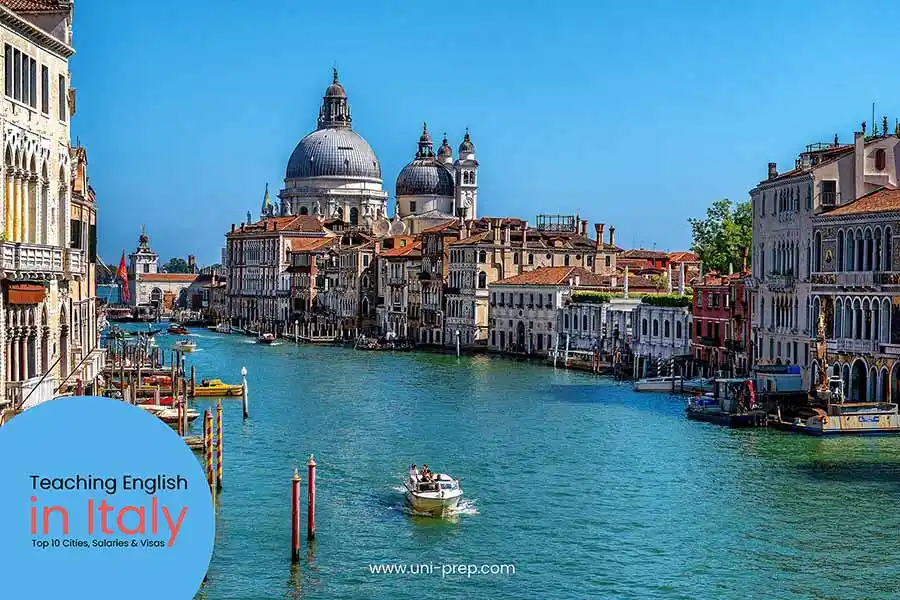
Why Teach English in Italy
Starting a career as an English teacher in Italy brings several excellent professional, financial, and personal benefits. For example, based on experience and the institution, full-time English teachers here can earn on average between €1,000 and €1,800 per month. Alongside your main job, you can also earn extra by giving private tuition or online classes, at €15 to €30 per hour. On top of that, experience teaching within the European education system will greatly strengthen your international CV.
If you're someone who loves to travel, then with an Italian work permit or residence permit you can travel to all 26 countries of the Schengen area without needing a separate visa. You'll get the chance to directly enjoy the art, architecture, and Italian food of world-famous cities like Rome, Florence, or Venice.
Compared to other Western European countries (such as the UK or France), the cost of living and eating in Italy's smaller cities is also quite low. Furthermore, by maintaining a contract-based job, a path can open up for staying in Italy long-term and later applying for permanent residence (PR). It's for all these reasons that people are eager to go to Italy.
Qualifications Needed to Teach English in Italy
To teach at Italy's various language schools, international schools, and in private tuition, some general qualifications are required.
1. Teaching Certificate (the primary qualification)
To get a job at any private language school, you must have at least a 120-hour online or offline TEFL or TESOL certificate. Holding a Level 5 Diploma can earn you €3–7 more per hour. If you want to apply to a well-known international school or a large institution, then Cambridge's CELTA certificate will put you far ahead.
2. Educational Qualification
A degree is not mandatory, but if you want an international school or visa sponsorship, then generally at least a bachelor's degree in any subject is required. Those with degrees in English, literature, or education are given preference. However, at some private institutions or summer camps, opportunities may be available with just a certificate, even without a degree.
3. Language Proficiency
The applicant must be fluent and articulate in English (CEFR level C1 or C2). Native speakers (such as citizens of the UK, USA, or Australia) are in the highest demand, but non-natives must show proof of studying in English or a good IELTS score. Knowing Italian is not mandatory for teaching, but knowing basic Italian is helpful for daily life.
4. Work Experience (optional but helpful)
It's possible to get a job at language academies even without prior experience. However, if you have at least 1–2 years of prior experience teaching English, your chances of landing a well-paid job increase.

Top 10 Cities for TEFL
In Italy, the most opportunities and jobs teaching English are found in large, tourism-heavy cities. Below is a list of the top 10 cities in Italy for English teachers.
1. Milan
Milan is one of the best and most lucrative cities for teaching English in Italy, though it is also quite expensive. If you want to teach business English or work in the corporate sector, then Milan should be your number one choice.
Job Demand in Milan
Milan is Italy's economic, fashion, and commercial capital. There is huge demand here for teaching Business English to the staff of banks, multinational companies, and fashion houses. Milan has the highest number of private language schools in Italy, which hire teachers all year round. Milan has several well-known international and British schools that hire full-time teachers at good salaries.
Salary Range
Compared to other cities in Italy, English teachers in Milan earn the most. Full-time work at language schools generally pays between €1,400 and €2,200. If you teach a company's executives on a freelance or contract basis, you can earn between €35 and €55 per hour. Teaching students or professionals privately can earn around €25 per hour.
Cost of Living
Milan's biggest downside is its high cost. It is the most expensive city in Italy. The lion's share of expenses here goes to rent. A single room in a shared flat rents for €500 to €800, and a private studio apartment rents for over €800. Accommodation, food, and transport can cost a single person around another €1,050 per month. In the beginning, getting by in Milan on a basic language school salary can be somewhat difficult. But if you land corporate clients or more private tuition, good savings are possible.
Lifestyle & Transport
Milan's public transport (metro, bus, and tram) is the best in Italy and very affordable. For young people (under 26) it's just €22/month, and a regular monthly pass is only €39. Milan has three airports (Malpensa, Linate, Orio al Serio), and from here you can travel to any country in Europe very cheaply by train or plane. The city is extremely modern, vibrant, and a melting pot of international cultures.
If, alongside a TEFL/CELTA certificate, you have the mindset to work in a corporate environment, then Milan will be great for your career. But if you want a calm environment and to enjoy traditional Italian life at a lower cost, then Bologna or Turin may suit you better than Milan.

2. Rome
For teaching English in Italy, the capital, Rome, is a highly attractive and wonderful city. After Milan, this is where the most jobs are created for English teachers. However, compared to Milan's corporate culture, Rome's environment is far more traditional, tourism-based, and life-oriented.
Detailed information on Rome's job market, income, and cost of living is given below.
1. Job Demand
Rome is one of the world's top tourist centers. So there is a great deal of demand here for teaching English to staff in the hotel, restaurant, tourist agency, and air transport sectors. Additionally, there are plenty of private language schools here (such as British Council, Berlitz, Wall Street English). These institutions hire part-time and full-time teachers all year round. Local families in Rome also want to teach their children English from an early age. So the opportunity to work as a home tutor or give private tuition to school-age children is greatest here.
2. Salary Range
Salaries in Rome are slightly lower than in Milan, but quite good compared to other southern regions of Italy.
Average monthly salary: Full-time work at language schools generally pays between €1,200 and €1,800 per month.
Hourly contracts: Teaching part-time at various academies, you can earn €15 to €25 per hour.
Private tuition: Teaching students or professionals privately, you can charge €20 to €30 per hour, which is a major source of income in Rome.
3. Cost of Living
Although Rome is an expensive city, the cost of living is somewhat lower than in Milan. Rent in the city center is very high. But a little further out, a room in a shared flat can be found for €400 to €600. A studio apartment for living alone starts at €700. Accommodation, food, utility bills, and transport together cost a single person around €1,000 per month.
4. Lifestyle & Transport
Unlike Milan, Rome is not so mechanical or work-driven. People here love to enjoy life. For a taste of history, culture, and outstanding Italian food, Rome is incomparable. Rome's public transport (metro and bus) system functions, but at times it's quite slow and not as flawless as Milan's. However, transport costs are affordable.
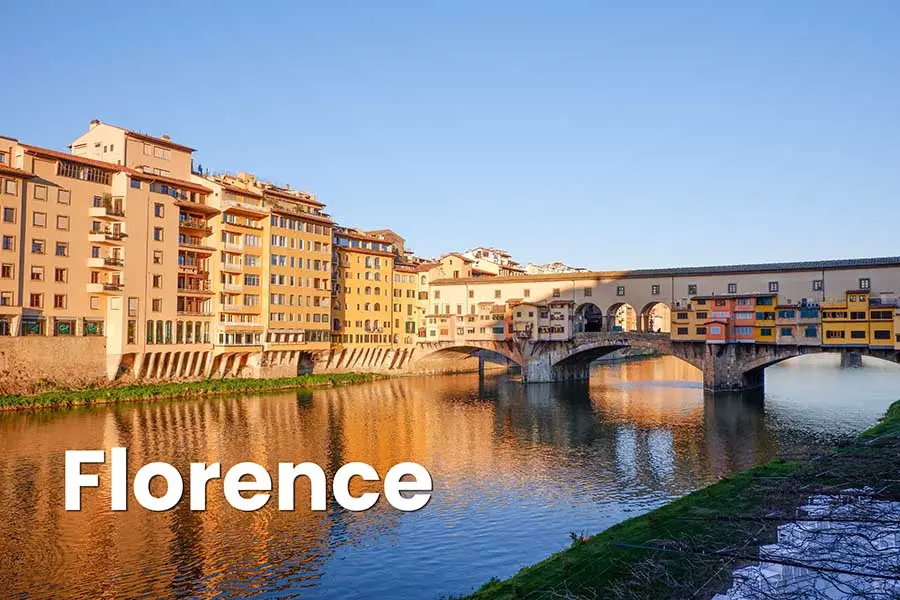
3. Florence
Florence, the capital of the Italian Renaissance, is an extraordinary and highly attractive city for starting a career in teaching English, or "TEFL." Although comparatively smaller than Rome or Milan, being an education and tourism center, there is quite good demand for English teachers here.
1. Job Demand
Florence has plenty of private language schools (such as The British Institute of Florence or Wall Street English) where English is taught to young students and adults. As Florence is a major international tourism hub, professionals in local hotels, restaurants, and the fashion industry are keen to learn English for the sake of their careers. Many teachers earn extra income by teaching part-time at various schools alongside giving private tutoring.
2. Salary & Cost of Living
In Florence, an English teacher's average salary is generally €1,200 to €1,700 per month, though depending on the type of institution and experience, it can range from €1,000 to €2,500. Although the cost of living in Florence is somewhat lower than in Milan or Rome, it is one of the more expensive cities in Italy. Apartment rent in the city center in particular is quite steep, so many teachers live in shared apartments.
3. Requirements
To apply to good schools in Florence, mainly three things are needed:
TEFL/CELTA certificate: Having at least a 120-hour recognized TEFL certificate is mandatory.
University degree: Having a bachelor's degree is advisable.
Visa and work permit: While the process is easy for EU citizens, getting a work visa is quite complicated for non-EU citizens. Many start out by coming on a student or digital nomad visa and doing part-time work.
4. Lifestyle
The biggest advantage of living in Florence is its rich history, world-famous art (such as Michelangelo's David ), and excellent Italian food. The entire city is like a living museum that can be explored on foot. However, due to the excessive crowds of tourists, the city is always quite busy.
If you want to enjoy a beautiful and refined lifestyle immersed in European culture and history, then Florence can be a great choice for teaching English.

4. Turin
Turin is a highly promising and strategically excellent city for teaching English in Italy. Just as Florence is famous for history and tourism, Turin is one of Italy's leading industrial, technology, and corporate hubs. For those who want to save some money alongside teaching, Turin is called a "hidden gem" of northern Italy.
1. Job Market
Turin is the center of famous carmakers and international design and technology firms. So there are plenty of opportunities here to teach corporate or business English to working professionals. With major universities here, including one of Italy's top institutions, Politecnico di Torino, there is good demand for English teachers for academic and IELTS preparation.
2. Salary & Savings
At private language schools in Turin, full-time teachers' average monthly salary is generally €1,000 to €1,600. However, income can be higher in corporate and business English. Compared to Milan, Rome, or Florence, the cost of living and apartment rent in Turin are much lower. Among Italy's big cities, Turin offers teachers the greatest opportunity to save money (highest disposable income).
3. Lifestyle
Unlike Florence, Turin is not packed with tourists, so you can enjoy Italy's wonderful authentic Italian culture here. As the city sits at the foot of the Alps, you get a great chance to be near winter sports and mountain nature. Its excellent café culture, baroque architecture, and regal streets will give you a taste of a sophisticated European lifestyle.

5. Bologna
Bologna is an extraordinary city for teaching English in Italy, known mainly for its vibrant student community and rich education system. As Europe's oldest university is located here, the city can be called Italy's "education capital." Beyond Florence's tourism or Turin's corporate environment, Bologna will offer you a huge and stable job market of young students.
1. Job Demand and Fields
Here, thousands of international and local university students look for private tutors or language schools to prepare for English exams and learn spoken English. There are regular job opportunities at well-known private language academies like Wall Street English, inlingua, or Berlitz. There is good demand for teaching business English to help professionals advance their careers.
2. Salary and Cost of Living
In Bologna, English teachers' average monthly salary is generally €1,200 to €1,900. Compared to large cities like Milan or Rome, the cost of living and rent in Bologna are much lower, though finding accommodation is somewhat difficult. To reduce costs, teachers usually live in shared flats.
3. Quality of Life and Environment
Bologna is called Italy's "food capital." Because of its wonderful historic red-brick architecture, long porticoes (covered walkways), and excellent cultural environment, living here is very enjoyable. You can explore the whole city by bike or on foot in just 15–20 minutes, which saves on transport costs. Bologna is called one of Italy's best food capitals. Its excellent social environment and vibrant nightlife make it easy for foreigners to adapt.

6. Naples
For teaching English in Italy, Naples is a city with moderate demand but is very affordable. While it doesn't have the huge corporate job market of Milan or Rome, interest in learning English among locals is growing rapidly. It's an ideal place for those who prioritize authentic Italian culture and lifestyle over a flashy corporate life.
Advantages and Positives
Compared to Milan or Rome, rent and food costs in Naples are much lower, which makes living here affordable. Demand for English is growing day by day at local public schools, private language academies (such as Speakeasy School or Cambridge School), and for private tuition. Here you can enjoy authentic Italian culture, world-famous pizza, and a historic environment without the excessive crowds of tourists.
Challenges and Limitations
Compared to Italy's northern cities, teaching salaries in Naples are quite low (generally €14 to €19 per hour). Here it's easier to gain experience than to build a big career. The job market is not as large as in Rome or Milan, so a bit more patience and networking are needed to find work.
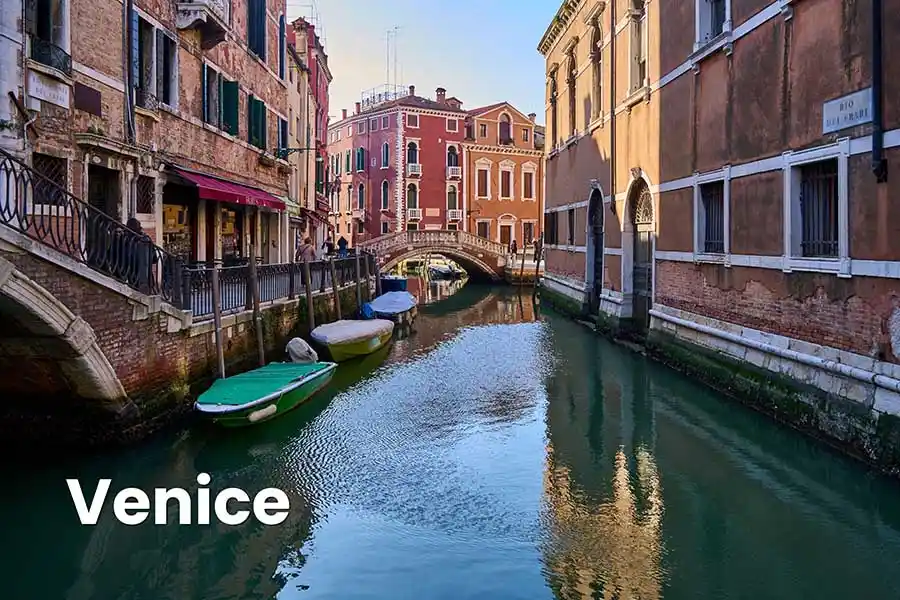
7. Venice
For teaching English in Italy, Venice is a wonderful and culturally rich city, but the job market here is somewhat smaller and more competitive than in Milan or Rome. Although there is demand for English speakers due to the tourism and hospitality sectors, the cost of living is quite steep.
Opportunities and Fields
The easiest way to teach English in Venice is through various private language schools or academies. Many locals connected to tourism and business show interest in learning English privately or at the institutional level. There are also good job opportunities in summer camps organized for young people or students.
Required Qualifications and Salary
Generally, a 120-hour TEFL certificate and a bachelor's degree are required. For full-time work, an average monthly salary of €1,000 to €1,500 is achievable, which can be increased further through private tuition.
Main Challenges
Being a tourist city, rent in central Venice and daily living costs are much higher than in other ordinary Italian cities. Getting a direct work visa is quite difficult for citizens from outside the European Union (EU), though many do part-time work on a student visa.
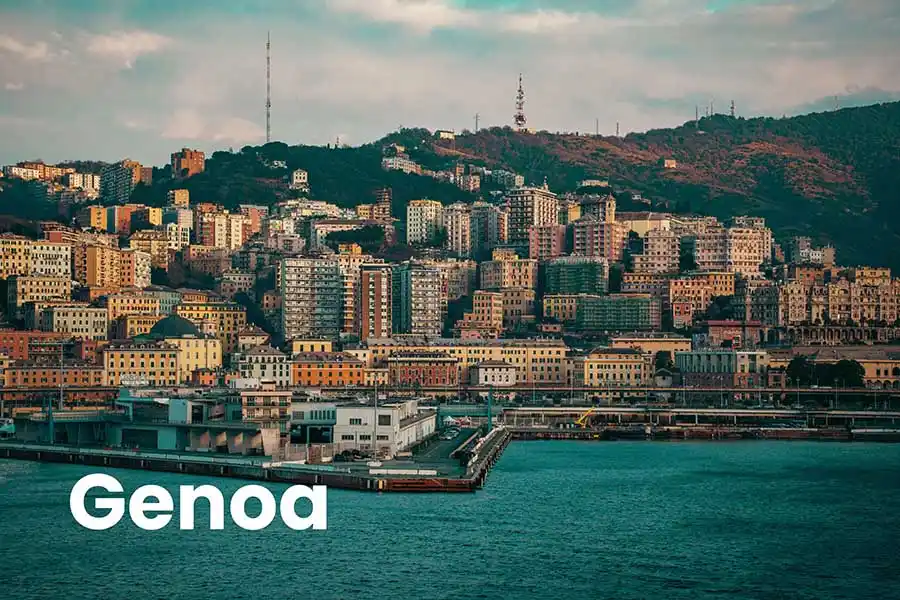
8. Genoa
For teaching English in Italy, Genoa is a great and promising city. As a port city, there is demand here for English centered on international business and tourism. Since it's not as overly tourism-dependent or expensive as Milan or Rome, you get a wonderful environment to blend in with the locals.
Job Market and Demand
Genoa has several well-known private language schools (such as My English School, Kids&Us, and Amalelingue). There is good demand here for teaching English to local business people, university students, and school children. Without knowing the local language, getting a job directly at a regular school can be difficult. However, you can use an online platform like Preply English Classes to teach local and international students.
Qualifications
Generally, to teach at good institutions here, having a Bachelor's Degree and a TEFL certificate is required. Along with that, having an EU work permit makes getting a job much easier.
Cost of Living
Compared to Milan or Rome, accommodation and living costs in Genoa are much lower. So it's possible to live comfortably here on an English teacher's average salary (€1,000–€1,500/month).

9. Verona
For teaching English in Italy, Verona is a wonderful, calm, and promising city. Although it doesn't have a huge job market like Milan or Rome, teachers quite like this city for its high quality of life and a stable work environment.
1. Job Market
Verona has several reputable language schools (such as The Cambridge School and Wall Street English). There are opportunities here to teach English to students of all ages and to corporate clients. As one of northern Italy's leading economic zones, there is quite good demand for learning English among local businesses and corporate professionals. It's possible to earn extra income here by giving private part-time tuition or teaching spoken English to school or university students.
2. Salary & Cost of Living
In Verona, an English teacher's average monthly salary is generally €1,100 to €1,500 (at language schools). Accommodation and food here cost about €900 to €1,250 per month. Costs are somewhat lower than in Rome or Milan, but a bit higher than in southern Italy's cities.
3. Quality of Life
Known as the city of Romeo and Juliet, Verona is extremely picturesque and a UNESCO World Heritage Site. The city is quite well-organized and its public transport system is excellent. Additionally, being close to Milan, Venice, and Lake Garda, you can travel very easily.
Requirements
To work professionally here, having a TEFL/CELTA certificate and a bachelor's degree is required. While EU citizens have direct work benefits, non-EU citizens need a work visa or a student visa with part-time work permission.

10. Padua
For teaching English in Italy, Padua (Padova) is a wonderful and highly promising city. Especially in terms of the balance between cost of living and income, it is considered one of Italy's best cities.
1. Positives and Advantages
Because of the historic University of Padua, it is a vibrant student city. There is plenty of demand here for learning English among international students and local professionals. Compared to Milan or Rome, accommodation and living costs in Padua are quite low. According to 2026 economic estimates, it is one of the best "best value" cities for maintaining a good standard of living at low cost. Here there are ample opportunities at renowned international schools like The English International School of Padua (EISP), various private language academies (such as Wall Street English), and for private tuition. The city is located very close to Venice, Verona, and Milan. Thanks to excellent train connections, it's ideal for touring Italy on days off.
2. Some Challenges
To get a job at a good institution, having at least a 120-hour recognized TEFL or CELTA certificate and a bachelor's degree is mandatory. If you are not an EU citizen, getting regular work sponsorship is somewhat difficult. However, using Italy's Digital Nomad Visa has now made it easier to work as a freelance teacher.

Visa Guideline for Teaching English in Italy
Getting a direct full-time work visa for teaching English in Italy is extremely difficult for non-EU citizens. So the visas used for teaching English in Italy are:
1. Student Visa + Part-time Work
This is the most popular route. You can get this visa by enrolling in a course at a recognized Italian university or language institution. A student visa allows up to 20 hours of work per week, with which you can teach English part-time at a language academy or give private tuition.
2. Digital Nomad Visa
This is for remote workers. If you have a contract or job teaching English online for an institution outside Italy, you can stay in Italy on this visa. For this, your annual income must be over roughly €28,000 and you must have a work contract of a fixed term.
3. INDIRE Government Program
Applications for this government program can be made every year in October–December, which creates direct work opportunities for non-Europeans.
4. Language Assistant Visa
Through an organization like the British Council, you can work as an English language teacher at various schools in Italy under the 'Study Mobility and Exchange programs' (Type D) visa.
5. Decreto Flussi (Annual Work Permit Quota)
Each year the Italian government sets a quota for how many non-EU citizens can enter the country for work. For 2026–2028, a total of 497,550 work permits have been approved over three years, with 164,850 in 2026 alone. These visas are mainly issued for the agriculture, hotel-restaurant, and construction sectors. However, under the non-seasonal quota, if an Italian language academy can give you an advance job offer, you can come as a general worker (though the chances of this are quite low).
You cannot apply directly for this visa yourself. An Italian employer (a language school) must apply for a "Nulla Osta" on your behalf through a first-come, first-served system called "Click Day." So getting a job offer/sponsorship in Italy in advance is the main condition.
7. Self-Employment Visa (Lavoro Autonomo)
This is for freelancers or independent entrepreneurs. If you want to work as a freelance English teacher or translator, you can apply for this visa. However, this visa's quota is extremely limited, and it requires showing sufficient bank balance and legal proof of business.
8. Spouse or Family Visa (Family Reunion Visa)
This is if your spouse or a family member is a legal citizen or permanent resident of Italy. Under this visa, after arriving in Italy you get the full legal right to join any institution as a full-time English teacher.

How to Start Your Journey?
To start your journey teaching English in Italy, you mainly need to follow three steps: earning qualifications, choosing the right visa, and applying at the right time.
1. Earning the Required Qualifications
-
TEFL certificate: To teach at Italian schools, having at least a 120-hour international TEFL or CELTA certificate is mandatory. So for a great start to your teaching career, join UNI-Prep's TESOL & TEFL Courses today. Complete the course fully online and at your own pace from home, and enjoy a globally recognized certificate.
-
Educational qualification: Most reputable institutions ask for a bachelor's degree (in any subject), but some private language schools may offer opportunities without a degree.
-
Language skills: Your spoken English must be fluent or at the level of a native speaker. Knowing Italian isn't mandatory, but it's good to learn basic Italian for daily life and communication.
2. Types of Jobs and Hiring Times
-
Private language school: This is the best route for beginners. There are more job opportunities in big cities like Milan, Rome, and Bologna.
Summer camps: These summer camps usually hire teachers for short terms around June to August.
-
Right time to apply: The main hiring seasons in Italy are August–September (for the winter semester) and January (for the spring semester). Arriving directly in Italy and handing in your CV in person gives you a much better chance of getting work than by email. Also, having basic Italian language knowledge for daily life will give you an extra advantage.
Conclusion
For many English teachers, Italy is a dream place, but the path to teaching English here isn't as easy as it seems. The pay is decent, life is beautiful, and the chance to travel the Schengen area is within reach but the real game is the visa: you can't just get one whenever you want. So before choosing a city, ask yourself one question: which route will you use to enter Italy? A student visa, digital nomad, or a school's sponsorship? This one decision will shape your entire journey.
Milan and Turin want corporate people, Rome and Florence move to the rhythm of tourism, and Bologna, Padua, and Naples are best for settling in at a low cost. But which city isn't the big question. Because whichever city you go to, the key that opens the door is the same: an accredited TEFL or TESOL certificate. Once you have that in hand, the rest is just a matter of time. So what are you waiting for? Start your first step today!