 by UNI-Prep Institute · Updated October. 4, 2026
Health insurance is usually the least-noticed part of an English teaching contract abroad. Yet it is precisely the kind of thing whose importance you only realize the moment you suddenly need to go to a hospital in a foreign country. Knowing that "health insurance is included in the contract" and actually understanding what that insurance covers, where it works, and under what conditions it can be cancelled, these are two entirely different things.

This distinction matters especially for teachers going abroad, because medical costs, visa conditions, and immigration law all depend on having an effective insurance policy in place. Not knowing a policy's limitations can leave you facing financial loss, and it can just as easily lead to legal complications such as visa or residence permit cancellation.
So in today's article, we will try to cover 10 things about health insurance that a teacher absolutely needs to know before going abroad to teach English. If you're an ESL teacher, or you dream of teaching abroad, we hope today's article will be genuinely helpful for you.
1. Having Insurance Doesn't Mean Being Protected
It's a common misconception that buying an insurance policy frees you from every kind of risk. In reality, insurance contains many subtle terms and limitations, because of which you can be deprived of financial help or medical care even in a moment of extreme crisis. Below are the main reasons why you may not be fully protected even with insurance in place:
Hidden Terms and Exclusions: Every insurance policy has a specific list of illnesses or accidents it will not cover the cost of. For example, pre-existing conditions , injuries caused by war or political unrest, or accidents from risky sports (such as scuba diving or paragliding) are typically not covered by standard insurance.
Out-of-Pocket Costs (Deductibles & Co-pays): If the policy has terms like "deductible" or "co-pay," you will have to pay a large portion of the treatment cost out of your own pocket. In the case of a major surgery, this out-of-pocket amount can often go beyond what an ordinary person can afford.
Maximum Coverage Limits (Policy Limits): Every insurance policy has a maximum monetary limit. If your treatment costs exceed that limit, you will have to arrange the entire remaining amount yourself.
Network Hospital Restrictions: If you receive treatment at a hospital outside the insurance company's designated panel or network, they may refuse to pay the bill or pay only a very small portion. In an emergency, this benefit may not be available at the hospital nearest to you.
Complications in Claim Denial or Reimbursement: Often, after being discharged from the hospital, when you file a claim for the bill amount, the insurance company denies it citing missing paperwork or some rule. Or getting your money back (reimbursement) can take months of running around, creating an immediate financial crisis.
In short, insurance is merely a tool for protection, not an absolute guarantee. Without carefully reading the policy's fine print and understanding its limitations, simply keeping an insurance card in your pocket can lead to a major shock in a moment of crisis.

2. Scope of Coverage: Exactly What Expenses Insurance Covers
Exactly what expenses a health insurance policy will cover depends entirely on the type of plan you've chosen and your premium. However, in a standard international or general health insurance policy, the scope of coverage is mainly divided into 3 categories. Below is a detailed breakdown of exactly which costs the insurance company takes responsibility for:
a. In-patient Coverage (Hospitalization)
When you need to be admitted to a hospital for treatment (usually more than 24 hours), the insurance company covers everything from the daily rate of a general bed or ICU to the visiting fees of the operating surgeon, anesthetist, and attending doctor. It also covers the cost of the operating theatre, surgical equipment and medication, as well as the cost of X-rays, MRIs, CT scans, or blood tests conducted while you are admitted.
b. Out-patient Coverage (OPD)
The cost of simply seeing a doctor or getting a consultation without being admitted to a hospital is often not included in many basic plans. It has to be added with a separate premium. If this is included in your insurance, it covers the doctor's consultation fee, the cost of buying prescribed medicine from a pharmacy, the cost of lab tests or an ECG done while at the OPD, and even necessary sessions like physiotherapy or acupuncture recommended by a doctor.
c. Additional or Special Coverage (Add-ons / Riders)
Add-ons/Riders usually have to be added to the main policy for an extra cost. Things like maternity costs, pre- and post-natal checkups, dental root canals, fillings, eye exams and the cost of glasses, and flu shots or other routine vaccinations fall under Add-ons/Riders.
Insurance companies use two methods to cover these costs. One is Cashless, where the hospital receives payment directly from the insurance company. The other is Reimbursement, where you pay the bill first and then submit receipts to collect the money back from the insurance company.

3. Pre-Existing Conditions: How Insurance Companies Consider Them
When going abroad or taking out a new international health insurance policy, insurance companies primarily treat your pre-existing conditions as High Risk, and handle them in various ways depending on the policy:
The most common method among international health insurance companies is to completely exclude your pre-existing condition from insurance coverage. For example, if you already have asthma, the insurance company will not cover any treatment related to asthma or the cost of an inhaler. They will cover the cost of all other new illnesses or accidents.
Some insurance companies cover pre-existing conditions conditionally, but this usually requires waiting 24 to 36 months. During this waiting period, you must not show any new symptoms of that condition, nor take any medication or treatment for it. After this period passes, the insurance company may consider covering the condition.
And if a company agrees to cover your pre-existing condition from day one, they will demand a higher premium from you compared to an ordinary person. This premium is determined based on the severity of the condition and the cost of regular medication.
However, if you get group health insurance through a large school or company, the company often does not take pre-existing conditions into account at all. This is called Medical History Disregarded , where regardless of your medical background, every condition is covered from day one. So it's wise to confirm this matter before signing the contract.
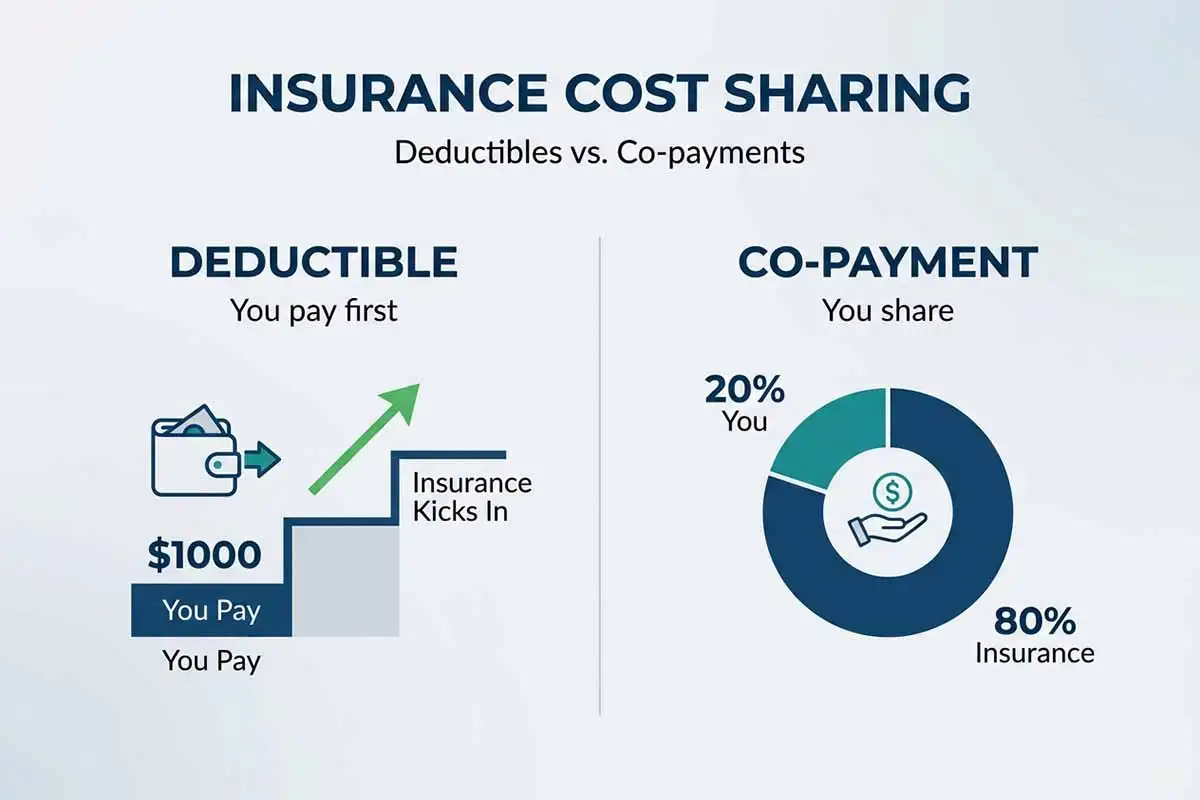
4. The Math of Cost-Sharing: Deductibles and Co-payments
The two terms may sound complicated, but they're actually simple. A deductible is an amount that you have to pay yourself before the insurance company starts paying. Let's say the annual deductible is one thousand dollars. Your first treatment costs eight hundred dollars, and the entire amount comes out of your own pocket. Your next treatment costs five hundred dollars. This time, paying just two hundred dollars fulfills the deductible limit, and the insurance company covers the remaining three hundred dollars.
A co-payment is a bit different. You have to pay a fixed amount or a percentage every time you receive a service. For example, if the visit fee is one hundred fifty dollars but your policy sets the co-pay at twenty dollars, you only have to pay twenty dollars, and the insurance company covers the rest. A co-pay can be either a fixed amount or a percentage.
How much your monthly or annual premium will be depends on this deductible and co-payment:
High Deductible = Low Premium: If you increase the deductible and co-payment amounts, your monthly insurance installment or premium will be much lower.
Low Deductible = High Premium: If you want to pay not a single dollar out of your own pocket when going to the hospital, your monthly premium or the cost of buying insurance will be much higher.
In addition, many policies include a maximum limit alongside these two items, known as the Out-of-Pocket Maximum . It is the cap on the most you may have to pay out of your own pocket in a year, combining the deductible, co-payments, and coinsurance. Once you reach this limit, all covered, in-network treatment for the rest of the year becomes 100% free. In the event of a major accident or surgery, this gives you a great deal of protection. Not every policy may have this limit, so check before you buy.
If you are generally healthy and don't need to see a doctor more than 1-2 times a year, you can go with a High Deductible/Low Premium policy. But if you regularly need medication, taking a Low Deductible/Co-payment policy would be the wiser choice.
Read More:
-
14 Effective Ways to Correct Errors Without Discouraging Students
-
14 Effective Ways to Correct Errors Without Discouraging Students
5. Claims Settlement Methods: Cashless or Reimbursement
How the bill gets settled depends on the type of insurance. This is mainly of two kinds: Cashless and Reimbursement .
Cashless Method
In this method, after treatment, the hospital sends the bill directly to the insurance company. You don't have to pay anything out of your own pocket (except for the deductible or co-payment portion, if applicable). In this case, even if you don't have enough cash on hand during a sudden major accident or operation, treatment won't be held up.
However, cashless benefits are usually not available at every hospital. The insurance company has a specific list of Network Hospitals. Before treatment, you need to confirm whether the hospital is on that list.
Reimbursement Method
In this method, you first have to pay the entire hospital treatment bill out of your own pocket. After that, you have to collect all prescriptions, bills, and reports and apply to the insurance company to get your money back. The company verifies everything and sends the money to your bank after a few weeks or months.
When going abroad, you need to have a large emergency fund or sufficient credit limit on hand. If a major operation's bill comes to $5,000, and you have a reimbursement policy, you'll have to arrange the entire amount yourself at that moment.
In this method, even a single receipt or doctor's signature being wrong or missing can lead the insurance company to refuse reimbursement. So it's essential to know precisely which documents are needed.
Many insurance companies offer cashless benefits for major treatment, but use the reimbursement method for seeing a general doctor or buying medicine from a pharmacy. That means small expense bills have to be saved up and claimed all at once at the end of the month or year. It's important to know this condition before taking out a policy.
Before going abroad, try to choose insurance that has a strong cashless network near your workplace. This will give you financial and mental security in the event of any major medical emergency abroad.

6. Geographic Limits: Where Insurance Works, and Where It Doesn't
Something that's often forgotten: insurance provided by a school is usually only valid in that specific country. The moment you cross the country's border, that coverage stops working. On top of that, risky activities like scuba diving or motorbike riding are also often not covered by standard travel insurance.
So before going abroad to teach, knowing your health insurance's geographic limits is extremely important. Because an international or travel insurance policy doesn't necessarily mean it works in every country in the world. Depending on the policy, insurance has a specific area or boundary of effectiveness. Here are the main reasons why you need to know this:
"Worldwide Coverage" vs. "Regional Coverage"
Not every international insurance policy covers the same payable area. Policies are usually divided into a few categories:
Regional: The insurance may work only in specific countries within Asia, Europe, or Latin America.
Worldwide: This is effective in almost every country in the world.
-
Worldwide, but excluding specific countries: Many policies state "Worldwide Excluding USA/Canada." That is, it will work in every country in the world except the United States and Canada.
The Reason Behind Excluding the USA and Canada, and Its Impact
Medical costs are highest in the United States among all countries in the world. So the insurance policies that include USA coverage have a premium or purchase cost that is double or more compared to standard policies. If you go to teach in Thailand or Oman and, on the way back home during a break or for a trip, take a transit or visit the United States, and an accident occurs there, without USA coverage you'll have to pay a bill worth crores of dllars out of your own pocket.
Coverage While on Vacation in Your Home Country
Many teachers think that since they have international insurance, they'll get medical benefits when they return home for vacation too. But most international expat insurance either doesn't work in your home country at all, or if it does, it's only for a very limited time (such as a maximum of 30 or 60 days a year).
So if you fall sick while home on vacation, not knowing whether your international insurance will work could land you in trouble. If necessary, you may need to think about a separate local policy or travel insurance for the time you spend at home.
One of the great advantages of teaching abroad is traveling to nearby countries during breaks. You need to confirm in advance whether your policy applies only to the host country, or whether it will also protect you while traveling to neighboring countries. It's essential to know whether your coverage stops the moment you step outside the border.
Exclusion of High-Risk Countries or War-Torn Regions
Insurance companies list certain countries or regions in the world as High-risk or Sanctioned zones. If you go to the border of such a region in search of adventure, or to teach, the insurance company will not accept any medical claim from there.
So when buying a policy, read its Geographic Limits or Area of Cover clause very carefully. Confirm with the agent whether the country you're going to teach in, and the countries you plan to travel to during breaks, fall within your insurance's geographic boundaries.

7. Mental Health: A Frequently Overlooked Area
As a professional English teacher, when you go abroad, having Mental Health coverage in your health insurance is extremely important. Because going abroad means adjusting not just to a new living environment, but also to the type of school, colleagues, and a completely new education system. Due to the pressure of classroom management, handling students from a different culture, and a new curriculum, teachers often suffer intense mental exhaustion or burnout in the first few months.
This mental exhaustion or burnout can lead to Clinical Depression or Anxiety Disorder . If something like this happens, and your health insurance doesn't have Mental Health coverage at that point, finding an English-speaking professional therapist or psychiatrist and getting proper treatment can become extremely expensive for you. So it's important to check the insurance terms before signing the contract.
8. Legal Obligations: The Relationship Between Visa and Insurance
In many countries, having health insurance isn't an optional matter. It's strictly regulated by their Immigration Law . If you go to teach English in a Schengen-area country in Europe, one of the main conditions of your visa application is to show a certificate of travel medical insurance with a minimum of €30,000 in coverage. This insurance must be valid throughout the entire Schengen area and must cover emergency repatriation costs alongside treatment. Without proof of this, the embassy will directly reject your visa application.
Some countries don't accept any other international insurance at all. They only accept policies from domestic insurance companies approved or listed by their own government.
Again, if you go to teach in a country like South Korea or Japan, obtaining the initial visa alone isn't enough. After arriving there, you have to get an Alien Registration Card (ARC) or residence card within a specific time frame. In Korea, the National Health Insurance Service (NHIS) is mandatory for everyone.
If you don't regularly pay the premium or installment for this government insurance, or if your insurance becomes invalid for any reason, the government will not renew your residence card. As a result, your work permit could be cancelled and you may have to leave the country.
Moreover, the moment you leave your home country and set foot in a new country, your school's official employment insurance doesn't start right away. Your employer's main government or private health insurance usually takes effect only once you have your residence card in hand or receive your first month's salary. This process can take 4 to 8 weeks to complete.
During this in-between period of 4-8 weeks, you remain completely uninsured. If an accident occurs or you fall ill during this time, you'll face a massive bill. Also, at some countries' immigration desks, you may be asked for immediate proof of coverage right upon arrival. If you don't have any temporary "incoming insurance" or travel insurance for the first month, you could face fines or immigration complications before even setting foot in the country.

9. The Policy Lifecycle: Renewal and Cancellation Rules
Before going abroad to teach English, it's essential to thoroughly understand the lifecycle of health insurance, particularly the rules around renewal and cancellation. This isn't just a piece of paper; it's the key to your legal validity and financial security. The main reasons are discussed in detail below:
Auto-Renewal and the Trap of Hidden Costs
Many international insurance policies auto-renew after their term ends. If you finish your teaching contract and return home, or move to another country, and don't cancel the policy on time, premium payments will automatically continue to be deducted from your credit card. You need to know in advance whether the policy needs to be renewed manually or whether it auto-renews. To stop auto-renewal, you usually need to give written notice at least 30 days before the term ends.
Risk of Visa and Residence Permit Cancellation
In countries like Germany, France, or South Korea, your visa's validity is directly tied to your health insurance. If the insurance company cancels your policy due to a delay in premium payment, the insurance company directly informs that country's immigration department. As a result, your work permit or residence card can become immediately invalid, and you may be issued a notice to leave the country.
Complications with the Official "Abmeldung" When Leaving the Country
In countries like Germany, for instance, if you don't show the insurance company an official deregistration certificate (Abmeldung) as required by that country's rules when you finish work and leave, they won't cancel your policy. Even after you've left the country, hundreds of euros in unpaid dues will keep accumulating every month, which can later become a major legal or financial penalty when you try to re-enter that country.
Cooling-Off Period and Refund Policy
If you realize right after buying the insurance that this policy doesn't meet all your school's or visa's conditions, you need to know the rules for cancelling it. Almost every international insurance company has a 14 to 30 day "cooling-off" or free-look period. Cancelling the policy within this time gets you a full premium refund with no penalty. But once this specific period passes, getting a partial refund or cancelling the policy becomes extremely complicated.
So before heading abroad, you should note down in a diary the deadlines for renewal and cancellation, the penalty rates, and the refund conditions in your insurance contract.

10. Medical Evacuation and Repatriation
While teaching English abroad, knowing about Medical Evacuation and Repatriation is extremely important, because these protect your life and financial security in any major health-related or life-and-death crisis.
Medical Evacuation
You may be teaching English in a country or remote region where the local hospital doesn't have advanced treatment or surgical facilities for complex conditions. If a major accident or complex illness occurs suddenly, you may need to be quickly transported by air ambulance or specialized helicopter to a more developed city or a hospital in a neighboring developed country. This transfer process is what's called Medical Evacuation. Without it, not receiving the right treatment at the right time can put your life at risk.
Standard health insurance usually covers hospital cabin rent or medication costs, but does not cover the cost of transporting a patient by air. The cost of renting a private air ambulance or medical helicopter can range from several thousand to over a hundred thousand dollars, which would be impossible for a teacher to pay out of their own pocket. If your policy includes this coverage, the insurance company takes on this massive cost.
Often, instead of taking long-term or complex treatment abroad, returning home to be with family for treatment is far more physically and mentally comforting. If you're covered for medical evacuation, and the local doctor believes treatment in your home country would be better than in your destination country, the insurance company will cover the cost of safely bringing you home under a doctor's supervision.
Repatriation of Remains
This isn't something anyone usually wants to think about, but while living alone abroad, one should be prepared for any extreme situation. If a teacher passes away suddenly while working abroad, bringing their remains back to their family in their home country, following national and international legal procedures, is an extremely complex and expensive process. If the 'Repatriation of Remains' coverage is included, the insurance company completes all the legal procedures and arranges, at full cost, for the remains to be respectfully brought home, relieving your family of a major financial and emotional burden during a time of profound grief.
Conclusion
International health insurance is essentially a system, where every part, from the scope of coverage to claims settlement and renewal rules, is interconnected. Neglecting one part can weaken the entire protective structure. So for a teacher going abroad to teach English, true preparation means fully understanding this system. Simply knowing that you "have insurance" is not enough.
Before signing the contract, it's wise to get clear answers from your employer or insurance agent about the policy's coverage, geographic limits, and cancellation terms. This awareness will protect you from unexpected financial and legal complications.
Preparing to teach abroad requires more than just insurance. It requires comprehensive preparation, from TEFL/TESOL certification to the visa process. For guidance at every step of this journey, check out the courses and resources at uni-prep.com.