 by UNI-Prep Institute · Updated November. 26, 2026

"Write out the words on the board!" We are all familiar with this scene. You spend a complete lesson with 20 new words: meanings, spelling, pronunciation. The group repeats after you in a chorus, and it appears that everyone knows it. The next day comes the test paper, and half the answers are left blank.
"Where did the words go?"
The issue is usually not that your students are lazy or that you don't put in enough effort. It's the method. If a word is learned only through memorization, or just once, it doesn't get ingrained in the brain.
The good news is that a lot of research is available on what sticks, and you can play with the first idea in tomorrow's class. If you teach ESL/EFL, or are thinking about it, this is for YOU!
Why Students Forget New Words
People forget new words as part of learning them. In 1885, the German psychologist Hermann Ebbinghaus demonstrated that new information slips away rapidly from memory when not reviewed, particularly early on. This phenomenon is called the " forgetting curve ."

The Hong Kong Education Bureau's vocabulary teaching resource package notes that teachers often introduce words within one topic and then move on, so the words get little further practice. It calls recycling earlier vocabulary crucial. It also mentions that a learner needs to meet a new word between 6 and 20 times before it is remembered.
That's why it is important to learn fewer words at a time and revisit them repeatedly through various methods. The five strategies listed below do just that.
1. Spaced Repetition: Spread Out Your Reviews
Why It Works
Spreading the same number of words over a few days helps you remember them better than learning them all in one day. A student's memory is reinforced when they recall a word just as they are about to forget it. This is known as the spacing effect .
How to Use It in Class
Give a short review regularly. Spend the first 5 minutes of every class revising some words from previous classes. It could work with a very repeatable pattern: teach a word, then review it the next day and again a few days later, and then once every two to three weeks.
Flashcards and Leitner box . In this game, students make paper cards that have the English word on one side and the definition and an example sentence on the other. Then put the cards in three boxes. This is a very simple way to play, but see if you can make it more interesting with your students.
Box 1: difficult words, review every day.
Box 2: medium words, reviewed every 3 days.
Box 3: easy words, reviewed once a week.
Any student who makes a mistake on a word returns it to Box 1. A correct answer moves the card up one box.
Digital tools. A flashcard app such as Anki decides which word to show and when, using spaced repetition. It is free on desktop and Android, so it works well for students' homework.
2. Active Retrieval Practice: Close the Book and Recall
Why It Works
Recalling a word yourself strengthens memory more than rereading it . In a famous experiment by Karpicke and Roediger , students learned Swahili-English word pairs. On a test one week later, students who kept being tested on a word even after recalling it correctly remembered about 80% of the words. Students who stopped being tested on a word after recalling it once remembered only 36% (if they kept restudying it) or 33% (if they stopped studying it too). It was a small experiment with 40 participants, but later research has found similar results .
Here, a test doesn't mean a grade. The test itself is a learning tool.
How to Use It in Class
Low-stakes quizzes. Take the stress out of marking. At the start or end of class, read out the definition (or a synonym) of 5 words and have students write each matching word in their notebook from memory.

Fill in the blank with partial clues. Instead of giving the word, give some of the letters. Example: "The king was very b_n_v_l_n_t to his people." (benevolent) Forcing the brain to think about the word from the clue keeps the brain active.
Word webs. Write one word in the center of the board. Students independently guess synonyms, antonyms, and parts of speech.
Tests with flashcards in pairs. One student demonstrates the meaning and/or displays a picture, while the other attempts to say the English word. Making an attempt to answer before looking at the answer is the real practice.
Tip: If a student gets stuck, don’t give the correct answer right away. Instead, wait 3 seconds, then supply the answer. If a student can remember a word on his/her own, they will remember the word for a long time.
3. Contextual Learning: Teach Words Through Context and Meaning
Why It Works
Simply memorizing a list of isolated words rarely helps students remember much. But when those same words are tied to a sentence, a story, an event, or a student's own experience, the brain remembers the meaning through that story or event. And words remembered through meaning stay with you far longer.
How to Use It in Class
Sentence first, meaning second. Instead of: "Gigantic means very big," write on the board, "The elephant is a gigantic animal". Encourage students to deduce the meaning from the sentence. And then, you both confirm it together, because a bad guess usually has this tendency to stick.
Words in a short story. Come up with two or three lines telling a short tale that uses the four or five words of the day. Students match each word to what occurs in the tale.
Link the words to students' own experiences. Have students create sentences using their own family, friends, or experiences. Use it with the word 'generous', for example: "My grandfather is a very generous man." Or simply: "When was the last time you were anxious?"
Teach word partners. Do not just teach 'appointment'; teach 'make an appointment'. Do not teach just the word 'decision'; teach 'make a decision'. This gives students context for the word in a sentence.

Reading material. Provide students with a paragraph containing all the relevant words in context several times. Reading shows how words function in practice.
4. Dual Coding: Pair Words with Pictures
Why It Works
Dual coding theory states that separate pathways process language and images. If the class uses only words, only one channel is used. Other routes back to the word include a picture, an object, or a gesture. If a student recalls the picture but forgets the spelling, he or she has a better chance of finding it again.
How to Use It in Class
Real-life objects (realia) and pictures. If you are teaching the word 'magnifying glass', come to class with a magnifying glass. If you cannot obtain the object, show a clear picture of it on chart paper or project one.
Word sketching. Students create a small drawing next to each word in their vocabulary notebook (e.g., a cloudy sky next to the word gloomy; a sad face next to the word sad). They don't have to draw perfectly. The connection between the word and the picture is what matters.
Flashcards with pictures. Place an appropriate picture above or below the word on each card. During the quiz, they look at the card and try to recall the word.
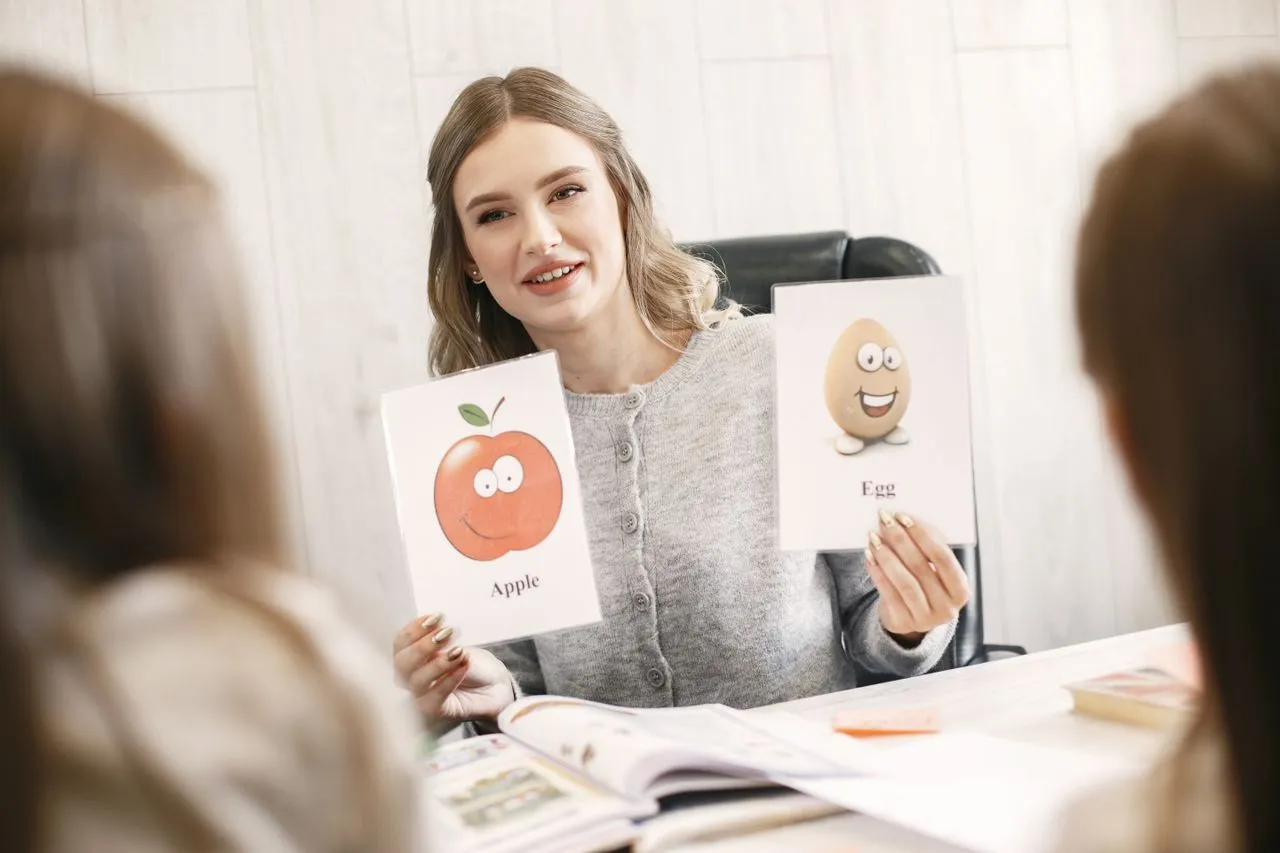
Nonverbal methods of communication, such as gestures and actions ( Total Physical Response ). Use this method with beginner and intermediate-level students. Walk slowly across the room to show "stroll," or make a tired face to indicate exhaustion.
Tip: Include a picture that matches the word and place it next to the word. Pictures and/or decorations that do not relate to the content may confuse students . Use a simple picture or a little acting for abstract words like justice.
5. Gamification: Use Games for Varied Practice
Why It Works
A word has to be repeated many times, and repeatedly teaching the same word is tedious. Students still use it in games and enjoy it because the word keeps reappearing in different forms. While games do not use magic, they can make recall, spaced review, and thinking about meaning more fun and easier.
How to Use It in Class
Vocabulary Charades. Show a word written on a slip of paper to one student, without letting the others see it. The student can't say anything; they can only act it out, and the rest of the class guesses what it is.
Taboo. Split the class into groups. One team must guess a word, such as beach. The person giving clues may not use certain words (ocean, sand, water, sea). This encourages students to consider synonyms and definitions.

Kahoot or Quizizz. Run a live quiz using either Kahoot or Quizizz during the last 10 minutes of your class if you have access to a projector and the internet. A live quiz is an engaging competition with points and a leaderboard, and can be used for retrieval practice reviews. Research on Kahoot! generally finds increased student engagement and motivation; however, studies on the effects of Kahoot! on students' ability to learn new vocabulary are inconsistent.
Silly sentences. Students create an odd or funny sentence using the new word. For instance: "A gigantic ant eats my book." Students share sentences, and the whole class hears the word again.
4 Practical Tips for Putting This into Practice
Fewer words, more depth. Instead of teaching 20 words a day, choose a few key words (4–5) and teach them well using the strategies above. It's our recommendation, not a requirement. There is no consensus on the ideal number of words per lesson, so raise or lower it based on your students' performance in low-stakes quizzing.
Use of a " Word of the Day " board. Designate a classroom area for the word of the day. Write the word, a simple meaning, and an example there, and display the week's words. Occasionally cover the words up and ask students to recall them.
Create a place where errors aren't a problem. Students will make mistakes as they attempt to recall or use new words. When they are reprimanded, they may not want to try out new words. Praise the attempt in front of the class, then explain the correct form separately.
Our article includes more techniques: 14 Effective Ways to Correct Errors Without Discouraging Students .
When to use students' first language (L1). Not every word can be explained in English, particularly for beginners. Where a word cannot be explained with a picture or by acting, give its meaning in a word or two in the students' first language. It saves time. But it doesn't end there. Then, have students use the word in an English sentence.
Which Words Should You Teach First?
Not all of the words are useful in the same way. Use words that your students will use most:
Everyday words. Words students meet and use outside the classroom come up more often, so they get more chances to be recalled.
Common words first. About 2,800 of the most frequently used English words in the New General Service List (NGSL) cover roughly 90% of general written English. It makes more sense to teach these words first in the early stages.
Introduce words before reading. Introduce some challenging words in a text before students read it so they won't get stuck on them during reading.
Students' own picks. Rotate the role of "Vocabulary secretary". This student records unfamiliar words used during the week, which they practice in the following lesson.
How should you adapt your teaching to age and level?
Not all methods work equally well for all students:
Children: Songs, pictures, games, and action (Total Physical Response) are best.
Teenagers: Teach through music, movies, and the words they use to express their feelings.
Adults: Teach words they need for work and daily life. Adults often want to use new words right away.
Beginners: Direct word teaching with flashcards and pictures works best. Quick wins build confidence.
-
Intermediate students: Practice the multiple meanings of one word, word families (beauty, beautiful, beautifully), and prefixes and suffixes (un-, -less). One word leads to many.
Advanced students: Study academic vocabulary, do lots of reading (extensive reading).
To learn more about teaching different age groups and levels, you can read our Complete ESL Teaching Guide for Beginners .
Here is one way to combine all five strategies. It is our suggestion, so adjust it to your class.
-
Monday: Give four or five new words – give context, have a picture, have some acting. Review at the end of class for 2 minutes.
Tuesday: Brief 5-minute quiz on Monday's words.
Thursday: This week's words and last week's words are back in a game (Charades or Taboo).
-
The following Monday: Conduct a flashcard test or have the students create their own sentence with each word.
Once a month: If you wish, do a review quiz on Kahoot covering the month's vocabulary.
Conclusion
There is no magical way to learn English vocabulary; it is a well-organized procedure. Words get into long-term memory with these five strategies: Spaced Review, Closed Book Recall, Words in Context, Words with Pictures, and Games. You don't have to do it all at one time – begin tomorrow by taking a 5-minute quiz on the words of last lesson.
Knowing the strategies is different from using them well at each age and level, which takes proper training. UNI-Prep's TESOL & TEFL courses prepare you to become an internationally recognized English teacher. Each includes vocabulary teaching, classroom management, lesson planning, and assessment units. No experience is needed.
Begin with the 120-hour TESOL & TEFL Certificate , available online for a learner-paced course. The 250-hour TESOL & TEFL Diploma is a course that includes a practicum series and 10 specializations. If you want to learn with an instructor and, as an ESL teacher/instructor, teach an actual student, you'll want to go with the Weekend Live Online TESOL & TEFL . Sign up today to further your career as a teacher.