 by UNI-Prep Institute · Updated November. 28, 2026
Ask a student to recite the Past Continuous rule, and you might get a blank stare. Ask the same student what happened in a story about a thief, a barking dog, and a dropped bag, and you'll probably get every detail.
Why does the mind hold on to stories so tightly? And can that power be used to teach English grammar and vocabulary? It can, and the way is simpler than you might think.
Grammar and vocabulary lessons are often where classroom energy fades: students memorize a rule on Monday and repeat the same mistake on Friday. Story-based teaching offers a practical alternative, placing new language inside a situation students genuinely want to understand.
This article gives you a classroom-ready starting point: a step-by-step method with a complete 45-minute lesson plan, and honest answers to the problems teachers meet along the way.
Stories are a strong tool, not a complete system, and the article closes with a path to building your skills through structured training.
How Does Language Get Into the Mind Through Stories?
Consider the English words that you can recall best. Do they belong to the ones you have memorized from a dictionary or to those which you have heard in a story, in a song, or in a movie? This is the main concept of linguist Stephen Krashen's comprehensible input theory: people learn a language when they get the message. He recommends that input be placed at a stage only slightly higher than the learner's current level (i+1), not too difficult, yet comprehensible. This is the point where teaching through stories becomes really effective.
-
Understanding the context: Copying "was reading" from a list is not identical to listening to "Mr. Rahman was reading a newspaper in the thief story below." The story events show you where each form fits in.
-
Effortless Repetition: The same structure shows up multiple times in the course of a story. No separate drill and no memorization.
-
Curiosity: The question of "what comes next?" is what keeps students engaged. The class never gets slow; students pay attention.
Research on this method reports encouragement, but with exceptions. In Ethiopia, a group of grade 10 students taught grammar through short stories performed better than another group.
Conversely, in a vocabulary study of Indonesian Grade 8 students, both digital stories and conventional methods improved performance, but the two groups showed no significant difference. So, rather than thinking stories are the only way, view them as a potent tool in your toolbox of teaching.
For more details on proven classroom techniques, read: 20 Proven ESL Teaching Strategies That Actually Work
6 Steps to Teach Grammar Through Stories
- Begin with the story and then proceed to the rule. Students first focus on the meaning of the sentences, then on the structure.
- Set one goal. Choose one structure, for instance, Past Continuous vs. Simple Past. It is sufficient to use one grammar point for each story. Don't include too much information or too many structures. It will be complicated for students, and they can get lost in the plot or lose interest in the class/lesson.
- Ask questions throughout the story to guide them. Don't start with structures or rules. Tell the story, occasionally prompt with a brief question ("What was in the thief's hand?"). In the TPRS (Teaching Proficiency through Reading and Storytelling) approach, this back-and-forth of questions and answers increases input.
- Help students notice the structure. Put it down in writing: Give them the story. Have them color or underline the target structure, then help them draw a timeline of the events.
- Let students discover the rule on their own. When introducing "This is the Past Continuous," use a concept-checking question first: What was happening when the event took place? Which of these took place suddenly? When students discover it on their own, briefly verify it (in one minute or two).
- Change the tense and retell, then create their own. Have students retell the same story but change the tense (past to present): A thief enters Mr. Rahman's house. Mr. Rahman is reading a newspaper... Next, have them work in pairs to write a short story or alternative ending.
For more details on teaching grammar with interactive techniques, read: 10 Interactive Techniques to Teach English Grammar
Example 1: Past Continuous vs. Simple Past
Yesterday evening, a thief entered Mr. Rahman's house. At that time, Mr. Rahman was reading a newspaper, his wife was cooking in the kitchen, and their dog was sleeping near the door. Suddenly, the dog woke up and started barking. The thief dropped the bag and ran away.
Ask the following question about the story: "What were the others doing when the thief came in?"
Answer: was reading, was cooking, was sleeping. These are actions that are still happening ( Past Continuous ).
Then ask: "What happened suddenly?"
Answer: woke up, started, dropped, ran, entered. These are sudden events ( Simple Past ).
Without a single rule being stated, the students have spotted the difference.
Example 2: Prepositions
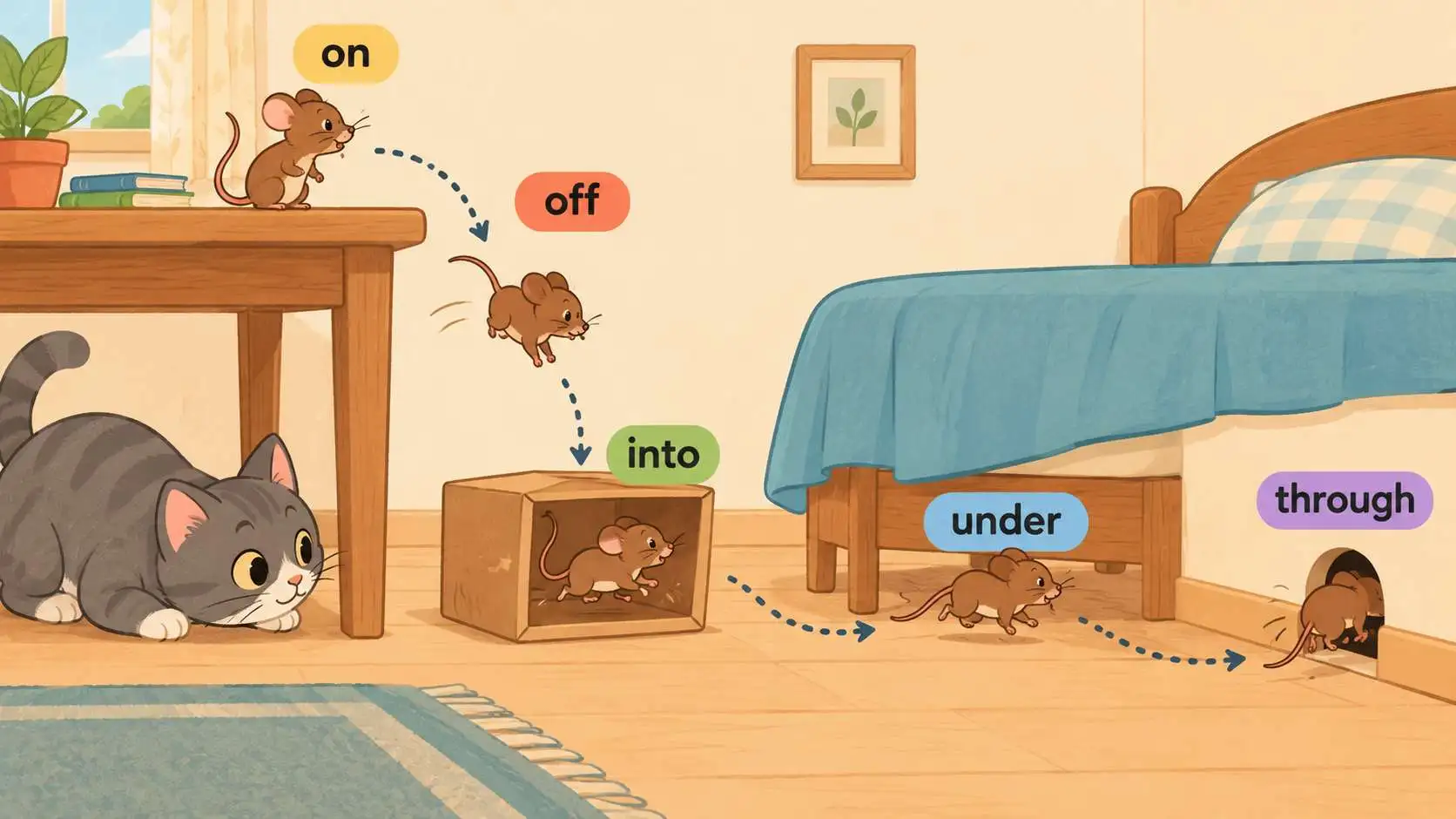
The naughty cat saw a mouse sitting on the table. The mouse got scared and jumped off the table. It ran into a small box. The cat tried to look inside the box. The mouse came out and ran under the bed. Finally, it escaped through a tiny hole in the wall.
When you tell the story, act it out with your hands (on = on top of, off = down from, into = going inside, under = below, through = passing from one side to the other). Since prepositions are mainly about location and motion, demonstrating them is far more realistic than memorizing.
Example 3: The Three Conditionals
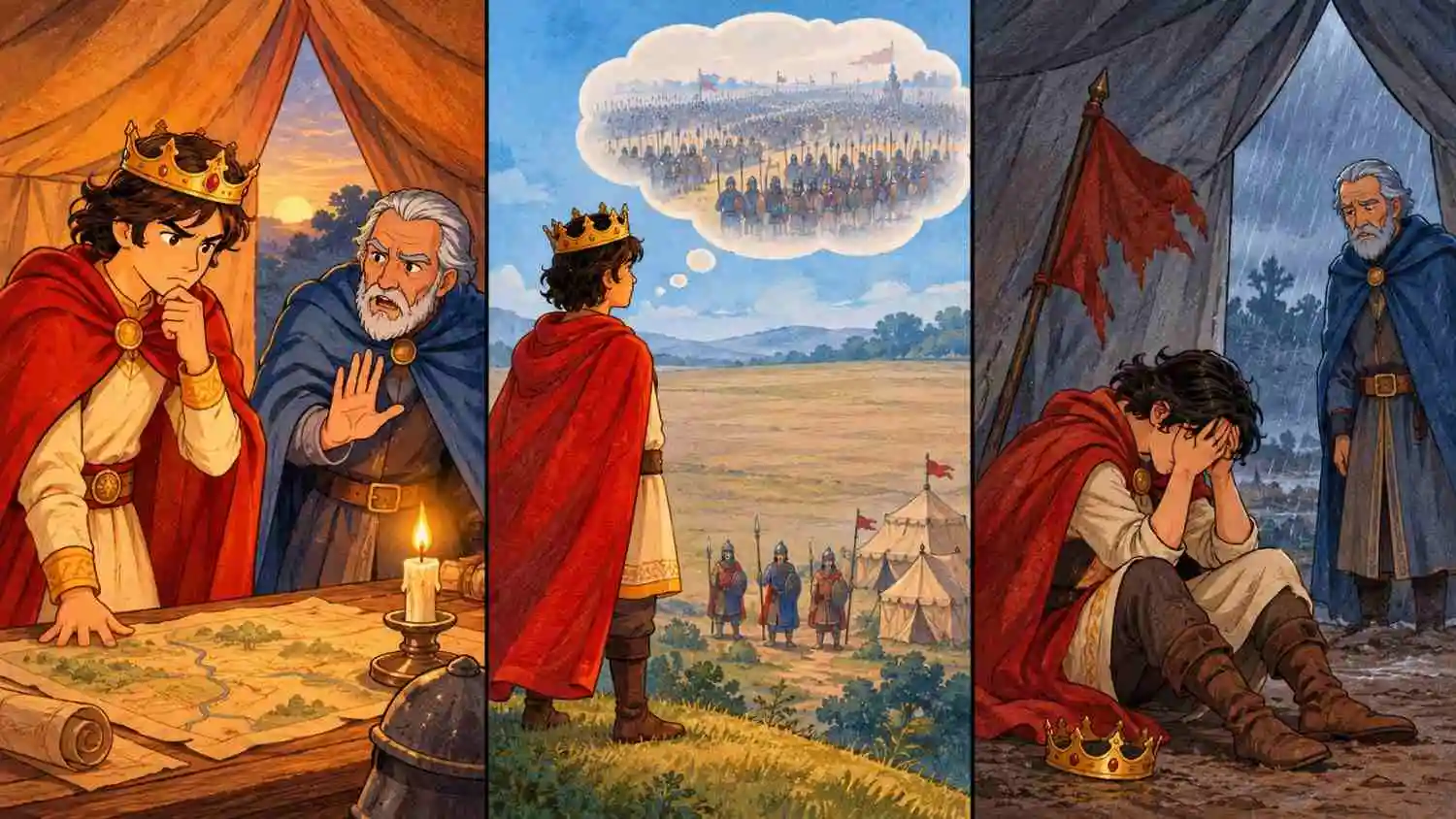
Rather than teaching types of conditionals as separate formulas, they can illustrate them in three moments from a single story.
Plot: A king goes against his commander's order and attacks at dawn while the latter tries to convince him to wait. He loses the battle.
Type |
Moment in the story |
Sentence |
|---|---|---|
|
First (real possibility) |
The night before the battle, the king is thinking about what will happen if he attacks at dawn |
If we attack at dawn, we will win the battle. |
|
Second (imaginary) |
The king knows his army is small, and wishes it were bigger |
If I had a bigger army, I would not be afraid. |
|
Third (regret about the past) |
Having lost the battle, the king weeps in his tent |
If I had listened to my commander, I would have won the battle. |
Say each sentence at its moment in the story, then ask three questions :
Can the dawn attack still happen? (Yes, so it's the First.)
Does the king have a bigger army now? (No, so it's the Second.)
Is the battle over? (Yes, so it's the Third.)
This way, students will work out for themselves which type is used when. When the time is up, have everyone come up with one "If..." sentence about this story.
Example 4: Past Perfect
The prince walked into the garden and stopped. He had never seen such a beautiful flower before. His mother had planted it years ago, but nobody had told him about it.
Ask:
"Had the prince ever seen such a beautiful flower before?" (No.)
"Was the flower planted before or after the prince walked in?" (Before.)
Now the students will tell you: to show what happened before another event in the past, we use had + V3.
6 Methods for Teaching Vocabulary Through Stories
1. Let students guess new words from the situation
Try not to start with a list of new words with meanings, definitions, and all. Put the new words in the story where the context of the other sentences suggests the word. This will enable your learners to guess rather than memorize a definition. This will help them when they encounter new words in their reading . It's easy to do in three steps:
Insert one or two sentences around the word that tell what it means: what someone is doing, or what it means to them.
Following the narrative, ask a question and have students state the meaning.
Check their guesses. When a guess is correct, back up the guess; when it is incorrect, identify it and explain its meaning if necessary. Next, have students create a new sentence using the word.
For example:
The old merchant was benevolent. Each winter he gave out warm clothes to the poor villagers and never left anybody without anything.
Ask: "The merchant gave clothes to the poor and never turned anyone away empty-handed. What kind of person is he?" Students will say "kind" on their own. Without a dictionary, benevolent is now tied to an event in their minds.
This topic is covered in more detail in: 5 Fun ESL Games to Teach Children English Vocabulary
2. Use the same word in different contexts
Students often struggle to remember new words after the first try. If they face the same word repeatedly in a story, students will see the word in each line in a different context and will see the meaning of the word and how it is being used. Make sure the repetitions aren't boring. So try to present the word in new sentences and in a different voice. And do this for 1 or 2 target words in each story, not for all the words.
For example, if the word for the class is generous, you could start the story with: "The king was very generous." Then, "Because of his generous heart, everyone loved him." Finally, "The generous king thanked the traveler."
The same word is in each of three different structures. It will take a different number of encounters for a word to stick, depending on the word and each student, so be sure to check again in the next class.
3. Match emotions to words
It is easiest to talk about feelings in a story, as students relate to a little of what the character feels. Pick a scene with an obvious change in emotion , and try to show it in your tone of voice and facial expression. End with a question about whether students have ever felt this way.
After searching for his lost puppy for three days, Robin found it behind a bush. He was ecstatic and hugged the puppy tightly. But his joy turned into a melancholic silence when he noticed the puppy's broken leg.
That story has two contrasting emotions: ecstatic and melancholic. When words are tied to an emotional context, they are often easier to remember, and students can use them and share their own emotions .

4. Teach words with their partners (collocations)
The method is very easy: If you teach a new word, do not write it by itself. Write it and say it with its "real" partners, such as not decision but make a decision. If students can recall the pair as a whole phrase, they will not be as likely to make errors when creating sentences from isolated words. Include 4 or 5 familiar pairs in a story and then write the entire pair on the board after the story.
There are many English words that go with a specific partner. Strong tea, not Hard tea; Heavy rain, not Strong rain. These couples naturally occur in a story:
Rayan had to make a quick decision. It was raining heavily, but he needed to get some cold medicine from the pharmacy. He took a shortcut, but he made a terrible mistake by leaving his umbrella behind. As a result, he got soaking wet.
This paragraph contains 5 collocations. Have students look for the pairs and circle them. This will provide an opportunity to prevent common errors, such as "I did a mistake."
5. Limit the number of new words
Students can't follow the plot or learn, no matter how fun a story is, if they have to use the dictionary for almost every word in it. Before you form the story, choose 4-5 words to learn today. The remaining words should be ones that your students are already familiar with. After writing, you should ask yourself one question: Will most of my students be able to easily comprehend this story?
For younger learners, introduce the key words before starting the story.
To learn more about teaching young learners, read: Teaching ESL to Children
Mina lived in a small village. One night, her grandmother gave her a lantern and said, "Go to the river and bring some water." Mina was afraid of the dark, so she began to hesitate at the door. But her grandmother smiled and said in a gentle voice, "Don't worry. The light will show you the way." Mina took a deep breath and walked out.
There are just three of the new words here: lantern, hesitate, gentle. The remaining ones are relatively simple, allowing students to easily follow along the plot. Present the three words with real or pictured objects, e.g., a picture of a lantern, a pause at the door for hesitate, and a soft voice for gentle. Then tell the story.
6. Allow students to make their own stories
When students try to create a new story, they not only understand the word, but also use it.
This work involves considering the word's meaning, where it fits in a sentence, and which words go with it. In one study of 40 students at an institution in Oman , the authors found that the group that made their own digital stories had a much larger vocabulary than the others. The easiest way to do this in class is to give students target words for a short story, or ask them to draw a comic of a story.
For instance, if you ask the students to retell the story using the three words listed above – lantern, hesitate, gentle – they may come up with something like this:
Rafi had a lantern. He hesitated on the dark road. His friend spoke in a gentle voice, and they walked home together.
When they've finished, students read each other's stories aloud. All you have to do is see if the words are being used in the correct sense. Catch small grammar mistakes later.

Storytelling Tips
A quality story isn't enough; the narration style matters, too. You cannot tell a story the same way you read from a book; you'll need to tell it at the right speed and watch the students' facial expressions as you tell it. The designs and approaches above come to life in the classroom through the story.
Here are some simple tips:
-
Pause in the middle of the story. Pause at two or three moments when the tension escalates. Ask, "What happens next?" then let students talk for a minute before sharing with the rest of the class.
-
Use the tone of voice, pronunciation, and expression . Speak in a low volume in a scary scene; speak quickly in an exciting scene. Extend your arms when something is big. A picture or small prop makes the meaning easier to grasp.
-
Match the story to your students' level . Use short stories that repeat words, phrases, and sentences for novices. Longer, more complex stories are suitable for higher levels.
-
Retell the story again. Give students opportunities to retell it more and more often, making it more comfortable for them.
-
In Online classes, create breakout groups for students to discuss, record short audio stories, or type their guesses into the chat.
For more interactive speaking ideas, read: 8 Interactive ESL Speaking Activities for Your Classroom
A Sample 45-Minute Lesson Plan
This is actually a sample of how the above techniques look in a single class. The full 45-minute lesson follows one thread based on a story in which one grammar point and a few new words are taught.
Goal: Past Continuous vs. Simple Past, and 5 new words.
Story: The following story is about a thief.
This is just a recommended sequence ; you can modify the sequence as needed for your class.
15 minutes, warm-up and story: Write the 5 new words on the board with their meanings. Share the story, stopping at 2-3 points to allow students to guess.
10 minutes, finding the structure: Ask students to color in the target structure in the written story. Ask questions to help them figure it out.
10 minutes, retelling in pairs: One student reads the story, the other listens, then they swap roles.
10 minutes, their own story: Ask them to write an alternative ending in 3–4 sentences. If time runs out, make it homework.
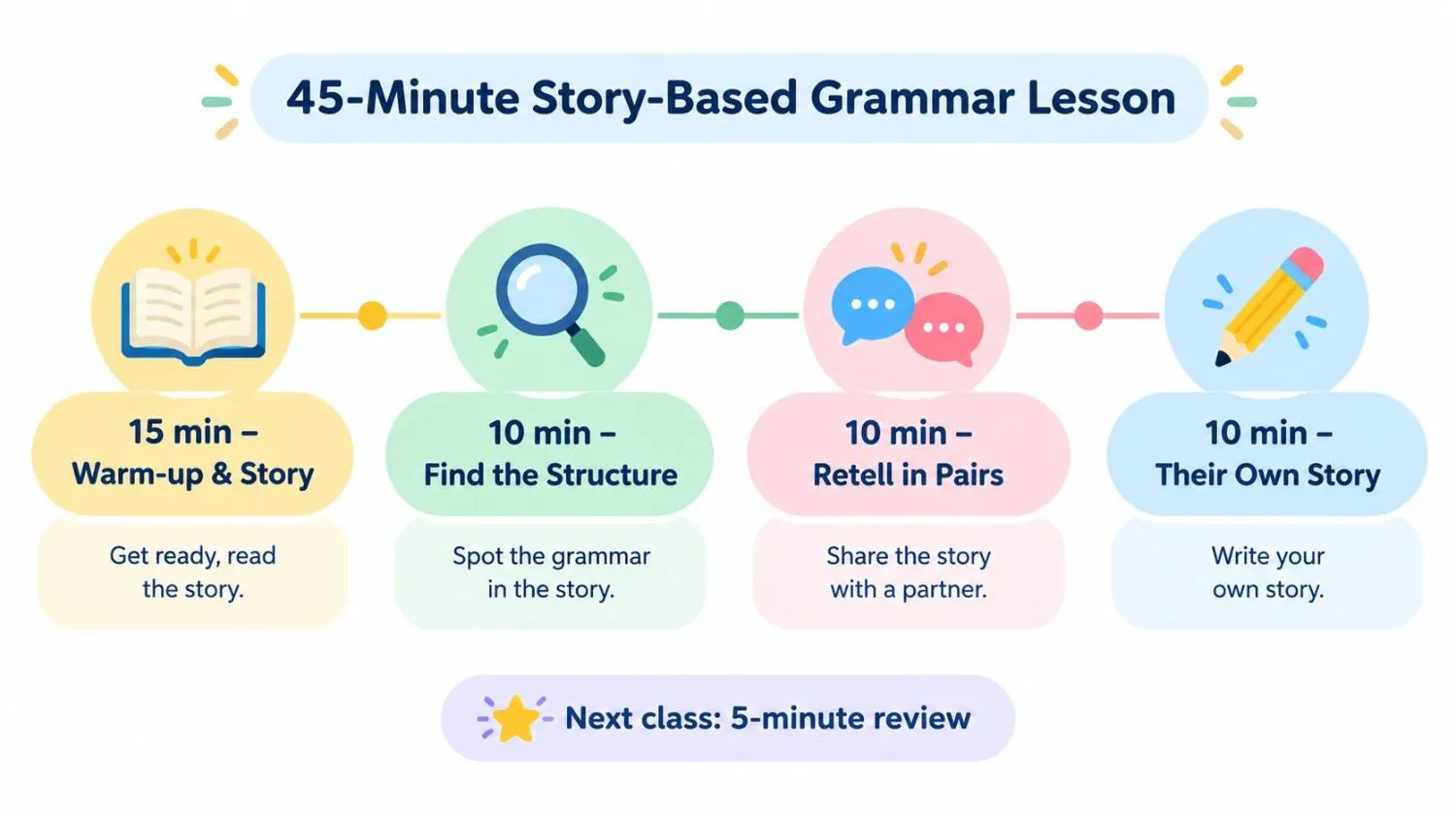 The next class should include a short (approximately 5-minute) review activity designed to measure students' retention
of what they have learned. This structure will work well for teaching many stories and grammar topics.
To learn more about building a lesson plan step by step, read: Complete ESL Teaching Guide for Beginners
Problems You May Face in Class, and Their Solutions
Teaching with stories sounds easy, but a few problems come up in almost every classroom. A small Malaysian study of three primary teachers reports similar challenges . The solutions below are practical suggestions, not research findings.
Time pressure. Choose short stories and keep one goal per lesson.
Large classes. Have students retell stories in pairs or groups, and walk around as you tell.
-
Finding stories. Write your own 4–6 sentence story around the target structure, or adapt folk tales, Aesop's fables, or moments from your own life.
Lack of confidence. Start with one structure, one story, one class.
Low-proficiency students. Use pictures, gestures, and a little first language.
-
Shy students and mixed levels. Let shy students speak in pairs first. Give mixed levels different tasks on the same story: weaker students arrange pictures, stronger ones write alternative endings.
-
Error correction. Don't interrupt mid-story. Afterward, correct 2–3 common mistakes together, or recast : reply "Oh, you went home?" to "I goed home."
-
Checking learning. Next class, give a 5-minute fill-in-the-blanks task or ask for new sentences with the target words.
To learn more about correcting errors without discouraging students, read: 14 Effective Ways to Correct Errors Without Discouraging Students
One caution: critics say story-based methods leave little room for direct grammar teaching and real culture , and one experienced teacher finds TPRS most effective up to A2 (one person's view , not a research finding). So add brief explanations and writing practice alongside stories.
Conclusion
Stories are a good method for grammar and vocabulary, but not the only method. They show language in context and bring your class to life. You don't need to change all your methods at once. Choose one structure, share one story, and test in one class. Then consider the results and proceed from them.
For a systematic approach to learning these techniques, check out UNI-Prep's TESOL & TEFL courses . The 120-Hour TESOL & TEFL Certificate course includes units on lesson planning, vocabulary, and grammar, plus a booklet of 100 classroom activities. For deeper learning, the 250-Hour TESOL & TEFL Diploma offers units specializing in areas like Teaching English Online, Business English, and IELTS. For those who want to learn live with trainers and classmates, the Weekend Live Online TESOL & TEFL course is for you!