 by UNI-Prep Institute · Updated September. 28, 2026
Teaching English grammar is one of the most important parts of language learning, but in conventional methods it often turns into a monotonous and passive classroom experience. Traditional methods that rely on memorizing rules and mechanical drills often fail to hold students' attention and interest.
However, modern language-learning research and Applied Linguistics have proven that teaching grammar through student-centered, interactive, and context-based methods is comparatively more effective and produces longer-lasting results.
So in today's article, we will discuss 10 techniques that ESL teachers around the world have successfully applied in their classrooms, enabling them to teach English grammar without boring their students. If you are an ESL teacher and want to teach English grammar to your students in an excellent way, I hope this article will be extremely helpful for you.

1) Test–Teach–Test
Test-Teach-Test (TTT) is a language teaching method where the teacher doesn't start the class by making students memorize a grammar rule, but instead begins directly with an activity or task. Its main purpose is not to give students any formal test, but to diagnose how much of that grammar point they already know or where they are making mistakes.
As a teaching method, its origin traces back to the early twentieth century. Professor Henry Clinton Morrison of the University of Chicago is called its inventor. In his famous Mastery Formula, he first mentioned the 'pre-test, teach, and re-test' cycle. The entire process is completed in 3 steps:
Test (1st test): Students play a task or game without the teacher's help, in which they need to use the target grammar. The teacher only observes where each student has gaps or is making mistakes.
Teach (teaching): The teacher explains only the specific gaps or problems students made mistakes on or got stuck on during the 1st test. There is no need to re-teach the entire grammar point from scratch.
Test (2nd test): Now students take part in another new and slightly more independent task or game using the same grammar, so the teacher can understand whether they have properly mastered the rule.
How to apply this in class
Suppose you want to teach "Past Continuous vs. Past Simple" in your class. Here's how you would structure the class to avoid boring your students:
Step 1: Test 1 (Time: 10-15 minutes) – "The Detective Game"
Don't mention any rule as soon as you enter the class. Go straight into a fun and realistic task. Tell the students, "Yesterday at exactly 8 PM, a laptop was stolen from the school lab. You are all suspects! Pair up and interrogate each other about what you were doing yesterday at 8 PM."
After that, walk around the whole class and listen to how they construct sentences. You might notice they're saying: "When the crime happened, I watched a movie." (which is grammatically wrong — it should have been "I was watching a movie"). Note down these mistakes in your notebook.
Step 2: Teach (Time: 15-20 minutes) – "Targeted Clarification"
Now write on the board only the mistakes that students made during the 1st test. Write two sentences on the board — one wrong and one correct. Ask the students themselves, "Which one sounds correct and why?" This is called Inductive Learning , or learning through discovery.
Now explain the difference between the concepts of Past Continuous and Past Simple by drawing a timeline or using fun gestures. Since the students just ran into trouble constructing these sentences, they will now listen to you very attentively.
Step 3: Test 2 (Time: 15-20 minutes) – "The Story Teller"
Now the students are armed with new knowledge. Give them another different and fun task to verify whether they've really understood the rule. Divide the students into groups of 4-5. Give them some comic strips or pictures (for example: a person walking and suddenly slipping on a banana peel and falling). Tell them to make up and tell or write a story based on these pictures.
Now notice whether the students are correctly saying: "While he was walking down the street, he slipped on a banana peel." When students see that they can form correct sentences themselves, their confidence will increase a great deal.
Why is this method the best for teaching grammar?
Removes boredom: Right at the start of class, students get the chance to speak or do an activity, so they stay active in class.
Saves time: The teacher doesn't have to waste time on what the students already know. Focus can be placed only where there's a problem.
Students see their own progress: The mistake they made in the 1st test, they can correct themselves in the 2nd test, which greatly increases their enjoyment of learning.
However, keep in mind that this method generally works best for Intermediate level or above students, who already have some basic understanding of English grammar.
2. The Inductive Method
The Inductive Method is a teaching method that goes from examples to rules. In the traditional way, we first make students memorize the grammar formula or rules and then give examples. But in the Inductive Method, you don't tell students any rules first. Instead, you present some real examples, texts, or scenes in front of them, and students themselves find a pattern or similarity among those examples and discover the grammar rule using their own intelligence. This is a completely student-centered and active learning process.
In modern scientific and logical thinking, the proponent of the Inductive Method is the famous English philosopher and scientist Francis Bacon . At the start of the seventeenth century, he spoke of this method for scientific inquiry, which was later adopted as an extremely effective method in language teaching and general education.
How to apply this in the classroom without boring students
Below are the 4 main steps to apply this method for students. Suppose you want to teach "Past Continuous Tense" in your class:
Step 1: Presenting data or examples
Instead of writing any rules on the board or projector, directly show some fun sentences or tell a short story. For example:
Yesterday at 5 PM, John was watching TV.
At the same time, his sisters were playing in the garden.
It was raining outside.
Step 2: Observation and analysis
Now divide the students into pairs or groups. Tell them to look at the sentences and notice a specific thing. You can give them some hints or questions:
Look at the bold words. What do they have in common?
When did these actions happen? Past or Present?
Why did I use 'was' in the first sentence and 'were' in the second?
Step 3: Generalizing the rule
When students are able to catch the pattern themselves, you help them organize and write the rule. Students will say themselves:
"Sir/Miss, we use Subject + was/were + Verb-ing when an action was ongoing in the past."
Since they discovered the rule themselves, it will stay etched in their memory for life.
Step 4: Practice and application
Now to make it even more fun, give a real-life task. For example: Alibi Game
Tell a fictional story in class that a theft happened in the school lab yesterday at 8 PM.
Have students ask each other in pairs: "What were you doing yesterday at 8 PM?"
They will answer: "I was having dinner," or "We were studying."
Pro tips for you as a teacher:
Act as a guide: In this method, the teacher's role is not that of a lecturer, but a facilitator. So instead of giving direct answers, guide students toward the answer through questions.
Use Realia: In an international school classroom, you can use pictures, comic strips, short video clips, or audio recordings to give examples, which will make the class much more engaging.
3. Task-Based Language Teaching
Task-Based Language Teaching , or TBLT, is a modern language-teaching method where students learn language and grammar directly by completing a real-world task. In the traditional method, instead of memorizing grammar rules first and then practicing them, in this method students discover the use of grammar and vocabulary themselves out of necessity while doing the task first. As a result, class is never boring or monotonous.
In the 1980s, Indian linguist and educator N. S. Prabhu first introduced this concept while running a project in Bangalore, India. Later, in the hands of various famous educators and researchers, the method became further developed and popular worldwide.
How to teach grammar by applying TBLT in class
A TBLT class is mainly divided into 3 stages. Below, with an example, it is shown how you can apply this in class without boring students. Let's assume your target grammar is Past Simple Tense and descriptive skills.
1. Pre-Task: The preparation stage
Instead of writing grammar rules directly on the board, you build students' interest. For example, tell a fun or strange short story of your own from a trip last week. This will help them understand what kind of work needs to be done today. You can write some necessary words or cue cards on the board if you want.
2. The Task Cycle: The main work stage
In this stage, students work in groups or pairs. Here, completing the task is more important than worrying about whether the grammar is wrong.
Divide students into groups of 4/5. Tell them: "Last year you all went to an island together to travel. Make up a thrilling story about what happened there." Students will discuss among themselves in English to come up with ideas.
Each group will prepare a short draft or report to present their story in front of the whole class. During this time, as the teacher, you'll walk around the class and gently help with the correct word or sentence structure if anyone asks for help. A representative from each group will briefly present their travel story in front of the whole class.
3. Language Focus: The real stage of teaching grammar
After the storytelling is done, it's time for grammar. By this point, students have understood that a special kind of sentence structure needs to be used when talking about past events.
Write some sentences on the board that students said during their presentation or from their draft. For example: "We go to the island" (wrong) and "We saw a tiger" (correct). Now ask them, when talking about a past event, should it be 'go' or 'went'? Students will themselves be able to catch the past-tense rule then.
Now, as the teacher, briefly explain the rule of Past Simple Tense on the board. After that, let them play a short game based on that rule or give another quiz, so they can polish the rule.
Some wonderful 'task' ideas to make TBLT effective
Depending on your students' level, you can use the following tasks:
The Menu Design (for Modal Verbs): Have students open an imaginary restaurant and create its menu and rules (for example: You must try our dessert, Customers should reserve a table).
The Invention (for Future Tense): Have students invent a strange gadget or robot that will be useful in the future. They will describe how it will work (for example: It will fly, It is going to help humans).
The Lost Luggage (for Questions & Negatives): One student will be an airport official and another a passenger whose bag has been lost. A question-and-answer session will take place between them.
In this method, students learn grammar not as a "punishment" or a "thing to memorize," but as a "medium" of communication, enjoying it along the way.

4) The Grammar Dictogloss
The Grammar Dictogloss is a Task-based language teaching method. In ordinary dictation, students write exactly what the teacher says. But in dictogloss, students don't write it verbatim. They listen attentively to a short paragraph read by the teacher, note down important words or keywords, and then discuss with classmates in groups to reconstruct the entire paragraph in their own way. It's during this reconstruction that they learn to use the target grammar themselves.
This method was first introduced in 1990 by Ruth Wajnryb , a famous Australian language educator and applied linguist, in her book Grammar Dictation.
How to apply this in your class
Below are Wajnryb's main 4 steps for applying dictogloss in an international school classroom:
Step 1: Preparation / Lead-in
First, create an engaging short paragraph or story of 4-5 lines using the grammar you want to teach, in which that grammar is used several times. Then, instead of explaining the grammar directly, have a short discussion with students about the content of the story or show pictures. If there are any difficult words in the paragraph, you can write them on the board.
Step 2: Dictation (listening and note-taking)
First reading: Tell students, "You won't touch a pen or pencil now. Just listen carefully to my story and try to understand the main idea." Then read the text at a normal pace.
Second reading: Now say, "I'm reading again, this time you won't write the whole sentence in your notebook, just note down the important keywords, verbs, or nouns." Read at a normal pace again this time too, and they will quickly take notes.
Step 3: Reconstruction (group work)
Now divide students into small groups of 4-5. Everyone in the group will combine their notes together. Then they will discuss among themselves and rewrite the paragraph read by the teacher. This is where the real magic happens! While joining sentences together, they will discuss: "Should it be 'has' here or 'had'?", "Should 'ed' go with this verb?" In this way, they will start actively thinking about grammar without even realizing it.
Step 4: Analysis and Correction
Have each group write the text they created on the board or show it on the projector. Now display the original text on the board. Ask students to find the grammatical differences between their own text and the original text. Discuss the mistakes openly in class and briefly explain the targeted grammar rule.
5) Contextual Gamification
Gamified Learning is a modern teaching method where, instead of making students memorize grammar rules, language is taught to students in a playful way within a specific context or story. Moving beyond the traditional boring lecture method, this makes students active and curious in class. No single person invented this entire concept; rather, it was discovered through a fusion of multiple theories of educational science and game design.
The term Gamification was popularized in 2002 by British computer programmer Nick Pelling . Later, Kevin Werbach and Yu-kai Chou did detailed work on the use of gamification in education. On the other hand, the foundation of Contextual Learning lies in the Constructivism theory of famous psychologists John Dewey and Lev Vygotsky.
How to apply this in class
Depending on your students' level, you can apply the following 4 ideas in class:
a. Grammar Auction
Divide the class into several groups and give each group some play money. Write some sentences on the board, some of which are correct and some of which contain grammatical mistakes.
Students will bid in an auction to buy the correct sentences. The group that can buy the most correct sentences and catch the mistakes in the wrong sentences will win. This makes students pay very close attention to sentence structure and learn to correct mistakes joyfully.
b. Escape Room Challenge
Turn the classroom into a detective mission. Tell students they are trapped in a room and need to unlock 3 lockers or codes to get out.
Each locker will have a grammar puzzle or clue to open it (for example: finding a wrong preposition from a paragraph to match the code). Within a set time, the team that solves all the grammar puzzles and can "escape" will get bonus badges or points.
c. Digital Quiz and Progress Bar (Digital Gamification)
Taking advantage of the tech-friendly environment of international schools, you can use tools like Kahoot or Quizizz. In the last 10 minutes of class, take a live quiz on the grammar covered. This shows a real-time leaderboard, which creates healthy competition among students.
d. Role-Play & Storytelling
Have students act out an imaginary character (for example: a doctor and a patient). Give them a task that they must use 'Modal Verbs' (Should, Must, Could) in this conversation. They will get points for correct and appropriate usage.
Some tips worth remembering:
-
Freedom to make mistakes: Just as games have lives or the chance to retry, give students in class a chance to "try again" instead of punishing them for wrong answers.
-
Variety in rewards: Instead of only looking at first and second place, arrange virtual badges or small rewards for "Best Teamwork" or "Most Improved Player."

6) Running Dictation
Running Dictation is a dynamic and collaborative language-learning activity where students can practice all four skills of the English language at the same time. In conventional dictation, the teacher speaks aloud while students sit and write, which can be quite boring. But in running dictation, students stay physically active, move around the classroom, and complete the task collaboratively.
In 1988, the famous language educators Paul Davis and Mario Rinvolucri first widely introduced and popularized this method in their book Dictation. Later, ESL/EFL teachers around the world (such as Jason Fritze, Michelle Worgan) further modified and modernized it.
How to apply this for teaching grammar
Although teachers generally use this for reading or vocabulary, it can also be excellently used to teach specific grammar rules (such as Tense, Conditionals, Prepositions, or Articles). Below is a step-by-step guide:
1. Preparation
Create a short paragraph of 4-5 lines or a few sentences focused on the grammar topic you want to teach. For example: if you want to teach "Past Continuous Tense," write sentences like: "Yesterday at 5 PM, John was cooking dinner. His sister was playing the guitar..." Print several copies of this sentence or paragraph and hang them on the back wall or in the corridor of the classroom in such a way that they can't be seen from the students' seats.
2. Dividing into groups and assigning roles
Divide students into pairs or small groups of 3-4. From each group, select one person as the "Scribe" or writer and the rest as "Runners" or messengers. The writer will stay seated in their spot with notebook and pen. The runners will run or walk quickly to the text on the wall.
3. Starting the game (The Action)
The runner will go to the paper stuck on the wall, read the first sentence, and try to memorize it. They cannot bring a notebook or mobile phone with them. Remembering it, they will walk quickly or jog lightly back to their group and whisper the sentence to the seated writer (so other groups can't hear).
The writer will listen and write the sentence perfectly in their notebook. If the runner forgets the whole sentence, they can go back to the wall to look again. After one or two sentences are done, swap the roles of runner and writer so everyone gets a chance to move.
4. Grammar focus and feedback
The group that finishes writing the entire text first with completely correct spelling and punctuation wins. But the real grammar lesson begins after this. Now tell students to find the specific grammatical structure from the text they wrote.
For example: "Everyone circle where 'was/were + verb+ing' appears and discuss with your partner why Past Continuous is used here." One group will check another group's notebook. If there's any grammar or spelling mistake, they will correct it themselves.
Why will international school students like this?
It works like a relay race or competition, which creates great excitement among students. International school students generally prefer Kinesthetic Learning (learning through movement and action) more. This method removes their monotony. It forces them to improve their memory power and pronunciation, because the runner has to pronounce correctly to tell the writer.
3 special tips for teaching grammar without boredom
-
Create confusion: In the sentences you put on the wall, deliberately leave in some grammar or punctuation mistakes. Tell students to correct those mistakes while writing. This will increase their critical thinking.
-
Rearranging the story: Put the grammar sentences on the wall jumbled up. After writing, have students arrange them logically to form a meaningful paragraph.
-
Competition and reward: International school students like a bit of challenge. Set a timer (for example: 5 minutes) and keep a small reward for the winning team (for example: a sticker or an appreciation token).

7) Find Someone Who
Find Someone Who is a classroom mingle activity. The teacher gives students a worksheet or grid (such as a chart of 9 or 12 boxes) containing some conditions or descriptions. Students' job is to walk around the whole class, ask classmates questions, and find someone who matches that description and write their name in that box.
How to apply this in a grammar class
If you want to teach your students a specific grammar topic (such as Present Perfect Tense or Modal Verbs) without boring them, you can follow the process below:
Step 1: Preparation and creating the worksheet
Create a list of questions or descriptions based on the grammar item you want to teach.
For example (for Present Perfect Tense):
Find someone who... has visited another country.
Find someone who... has eaten sushi.
Find someone who... has read a book in English.
Step 2: Teaching the rule for asking questions
Instead of directly giving students the worksheet, first show on the board how to turn a statement into a question. For example, the sheet says "...has eaten sushi," but when the student asks their friend, they will say: "Have you ever eaten sushi?" Through this, they get the chance to practice the correct grammar structure.
Step 3: Mingling or moving around the classroom
Have all students stand up from their seats with their worksheet and pen. They will walk around the whole class asking each other questions.
If a classmate answers "Yes, I have," the student will write their name in the designated box on the sheet.
If the answer is "No, I haven't," they will go ask someone else.
An important rule: a student's name can only be used once on the sheet. This forces students to talk to everyone.
Step 4: Follow-up and feedback
Once the activity is over, bring everyone back to their seats. Now you can ask a few students, "Who has eaten sushi?" Then students will answer, "Siam has eaten sushi." Through this, they will orally review the correct grammar rule of using "has" with third-person singular.
Why is this method the best in a grammar class?
You can find hundreds of ready-made resources for this method on trusted platforms like British Council Teaching English and Twinkl ESL Resources . The main advantages of this for teaching grammar are:
Traditional grammar class |
"Find Someone Who" method |
Students sit passively and memorize rules. |
Students stay physically active and move around the classroom. |
Only the teacher speaks (teacher-centered). |
Students talk among themselves to learn the language (student-centered). |
Grammar feels like just a paper-and-pen drill. |
Grammar gets a real-life application through real communication. |
This technique will help hold your students' attention and greatly increase their interest in English class.

8) CCQ + Timeline/Visual Grammar
Timeline / Visual Grammar is drawing a simple line to present time or tense to students like a picture. Through this, when an action started, how long it continued, and when it ended is shown with the help of graphics or symbols.
On the other hand, after teaching grammar, we usually ask, "Did you all understand?" Students almost always say, "Yes, sir/madam." But in reality, they don't understand. To stop this kind of dodging, CCQs are used. These are small, specific yes/no or one-word questions that let the teacher confirm whether the student has really understood the rule.
These methods weren't invented overnight by any single person. They mainly became popular worldwide through the CELTA and ESL teacher training system.
How to apply this in class?
You can apply this in the following 3 steps to teach grammar without boring students. We're taking Present Perfect Continuous Tense as an example.
Step 1: Creating Visual Grammar / Timeline
Draw a long line on the board or screen and mark Past, Present, and Future. Now give a visual form to the action in the sentence.
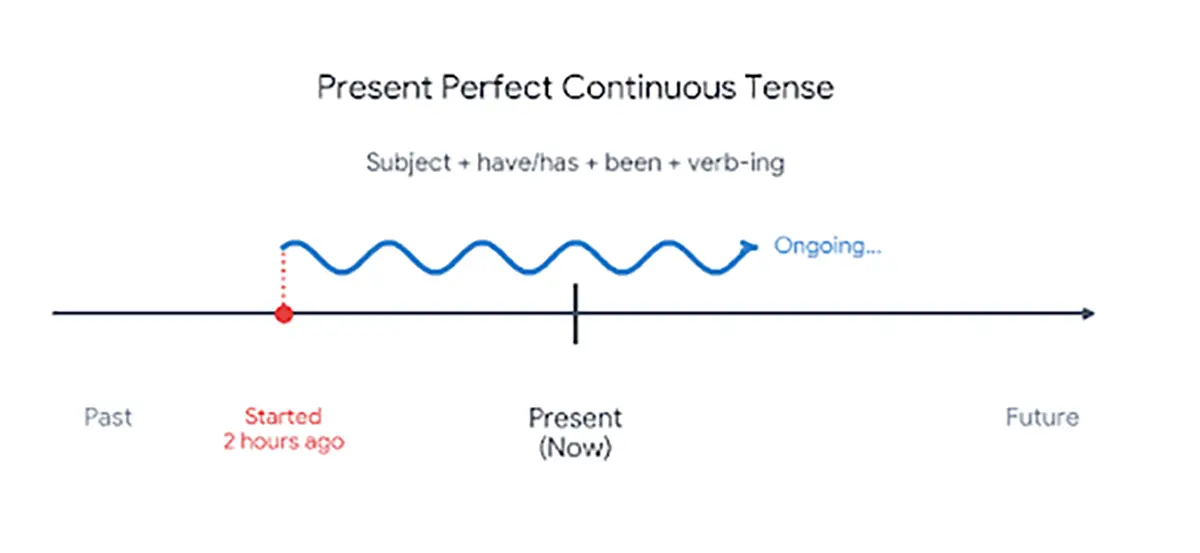
Tips for teachers: Instead of just drawing a line in chalk on the board, put a picture of a clock or emoji at the "past" spot, and put a picture of a tired person or write "Now" at the "present" spot. Seeing visual animation or pictures will immediately make students interested.
Step 2: Using CCQ (Concept Checking Questions)
After showing the timeline, ask small questions like the ones below to test students' understanding. Students will answer in one word.
Teacher: Is the waiting finished? Student: No.
Teacher: Did it start in the past? Student: Yes.
Teacher: How long ago did it start? Student: Two hours ago.
Teacher: Is the person still waiting now? Student: Yes.
Why isn't this boring? Students aren't passive listeners here. In answering each of your questions, they are brainstorming and discovering the grammar rule themselves (Guided Discovery).
4 pro tips for holding a class without boredom
-
Stop saying "Do you understand?": Asking this question usually makes students say "Yes" out of fear or embarrassment, even though they don't actually understand. Instead, always use CCQs.
-
Use of color (Color Coding): Use colored markers while drawing the timeline or writing the structure on the board. For example: write the Auxiliary Verb (have/has) in blue, and the Main Verb (waiting) in red. International school students are more used to visual learning.
-
Start with a story (Contextualization): Instead of writing the structure directly on the board, tell a real or fun story. For example: "Today when I was coming to school, I saw Jony standing waiting for the bus. When I entered class an hour later, I looked through the window and saw Jony still standing there! So, Jony has been waiting for an hour!" Then show the timeline.
-
Involve students while doing CCQs: Don't let only the good students answer the questions; call on names of students sitting in the back or inattentive ones for small CCQs. Since the questions are easy, they'll be able to answer, and their confidence will increase.
9) Kinesthetic Grammar Anchoring
Kinesthetic Grammar Anchoring is a modern teaching method that, instead of memorization, converts abstract or difficult grammar rules into a lasting memory or "anchor" through physical movement, gestures, and touch. This is an extremely effective method for the interactive and dynamic classrooms of international schools.
This is mainly built on a combination of Neuro-Linguistic Programming (NLP)'s Kinesthetic Anchoring — which links a mental state to a touch or action — and New Zealand educator Neil Fleming's famous VARK Model. Later, language experts like Alice Savage and Colin Ward created various activities based on this concept and popularized it in English classrooms.
How to apply this in your classroom:
You can apply this in the following 4 ways to teach complex grammar topics without monotony:
1. The Human Timeline (for teaching Tense)
This is the most wonderfully effective for teaching tense. Draw a straight line on the classroom floor with chalk or tape. The middle of the line will be "Present," the front side "Future," and the back side "Past."
When you say a sentence (for example: "I had finished my homework before he came"), students will need to walk or jump backward accordingly and stand in the right spot. By going two steps back for Past Perfect and one step back for Simple Past, they can physically feel the subtle difference between the tenses.
2. Parts of Speech "Dance" or gestures
Set specific gestures or sign codes for parts of speech like Verb. Right at the start of class, set the rule that whenever a Verb appears in a sentence, everyone has to clench their fist to show a display of power. If an Adjective appears, they have to pose like a model with their hand on their head.
You will write a long sentence on the board or say it aloud. As students read the sentence, the whole class together will do different physical gestures or poses based on each word. This will keep their attention held until the very end.
3. Preposition Tableaus
Using in-class objects or their own bodies to teach prepositions. Divide students into pairs. When you say "Under the desk," one person has to go under the table. When you say "In front of your partner," they have to come stand in front of their partner. International school students really enjoy this kind of physical task.
4. Sentence Construction Blocks
For teaching sentence structure or word order. Write the parts of a sentence in large letters on paper strips or different colored cards. Give these cards to a few students to hold on their chest or in their hand. Now instruct the rest of the class to physically pull or arrange these students to form a correct and meaningful sentence. Transformations from Active to Passive Voice can be taught very easily and enjoyably this way, through students physically changing positions.
Tips for teachers:
Whenever doing any physical movement in class, make sure it's meaningful. That is, there should be a direct logical connection between the movement and the grammar rule. In the multicultural classroom of an international school, this method greatly helps even shy students to speak up and become active.

10) Peer Review / Grammar Doctor
Peer Review is a process where students read each other's writing and find mistakes in grammar, sentence structure, and spelling, and give constructive feedback. Here, instead of correcting mistakes directly, the teacher gives students the opportunity to find their own mistakes themselves.
On the other hand, Grammar Doctor is mainly a fun, figurative form of Peer Review. In this method, students temporarily become "doctors" or "surgeons." The sentence or paragraph with grammatical mistakes in front of them is the "sick patient." Students' job is to diagnose the "disease" (grammar mistakes) and "cure" (correct) the patient using correct grammar.
In modern educational science, this has developed as part of the concepts of Process Writing and Collaborative Learning. In the seventies, educator Peter Elbow , and later writers like John Bean , highlighted the importance of peer feedback in developing students' writing skills. And Grammar Doctor is mainly a modern form of Active Learning and gamification, which ESL teachers around the world have created to make classrooms engaging.
How to apply this in class?
Depending on the age and level of your international school students, you can use the following strategies:
Grammar Hospital or Emergency Room activity
-
Create the patient: Write some sentences or a short paragraph on the blackboard or projector containing mistakes from the grammar item you recently taught.
-
Appoint doctors: Divide students into small groups. Declare each group a Grammar Doctor or Surgeon team. If you want, you can give them paper stethoscopes or doctor badges.
-
Prescription or operation: Their job will be to read the paragraph, mark the mistakes (disease) with a red pen, and write the correct form (medicine/treatment) next to it.
-
Medical report: A representative from each group will come up and explain what mistakes they found and how they fixed them.
Peer Review 'Writing Workshop'
-
Draft writing: Have students write 1-2 paragraphs on a specific topic (for example: "My last vacation").
-
Providing a checklist: Give students a simple 'Review Checklist.' For example:
Does every sentence start with a capital letter?
Is the tense correct?
Are there any spelling mistakes?
Exchanging notebooks: Now have them exchange notebooks with the classmate next to them. They will read each
other's writing and lightly circle or write notes according to the checklist with a pencil.
Correction and praise: After getting the classmate's feedback, the original writer will correct their mistakes and
write the final version. There will be a rule here — along with finding mistakes, they must also praise at least
one good thing about their classmate's writing.
Why will these methods remove boredom from class?
Students get an active role: Instead of the teacher talking non-stop, students work themselves, so they don't get the chance to fall asleep or lose attention in class.
Learning through play: Dressing up as a "doctor" or "detective" and finding mistakes feels like a game or challenge to students.
Fear is removed: Students feel less shame or fear correcting mistakes through discussion with a classmate than seeing the teacher's red-ink marks.
International standard: In international schools (such as the IB or Cambridge curriculum), this kind of critical thinking and collaborative skill is given great importance.
Conclusion
The ten techniques discussed above prove that the traditional, memorization-dependent method is not the only path for teaching English grammar. From Test-Teach-Test to Kinesthetic Grammar Anchoring, every method has a common foundation, namely: engaging the student as an active participant instead of a passive listener.
As a teacher, there's no need to apply all the methods at once. It's enough to consider the classroom environment and the age and level of your students, pick two or three methods, and gradually start applying them. Over time, this change will not only enrich students' grammar knowledge but will also turn the classroom into a place where learning itself becomes a joyful experience.
However, to apply these techniques perfectly, proper systematic training and professional skill are needed. If you are an aspiring or working English teacher and want to gain expertise in modern, student-centered teaching methods, you can check out UNI-Prep's internationally recognized TESOL/TEFL certificate courses. Here you will get hands-on training, expert mentorship, and a certification that will take your teaching career to the next level.